
Economic reform, inclusivity, and transformation are the most
frequently bandied concepts to articulate the solution to RSA’s economic
justice woes. While these might suit the demands of politically correct
rhetoric or nomenclature, they are not the real problem behind the economic
justice challenges of RSA. The real challenges are the templates of economic
domination with class, race, and a structural past as direction and magnitude.
Economies that change the per capita conditions for most households don’t do so
out of rhetoric; they succeed because of their end-state-based economic policy
designs.
Leaders
in such economies design so that the economic opportunities they create do not
impose themselves on future generations in a way that perpetuates the
inequalities or otherwise that were instructive during the design phase. The
encumbrances of the future, its economic justice demands and realities, and
society’s social justice expectations should reign supreme in determining RSA’s
national economic interests. Good design to upend the economic domination
templates improves the equalisation of opportunities with equity-driven
outcomes over time.
It
would be prudent, at least intellectually, for economic development planning
technocrats to be less occupied with making the status quo dictate the current cycles
of change that they don’t look at the bigger template fracturing picture. If an
economy wants sustainable growth, it needs not only to rely on foreign direct
investment, including from sustainably secured investors; it needs to develop
intervention programs and incentives that create or massify local investors
with a national sovereignty mindset. South Africa has no local investor problem
if its reserves in the financial services sector are anything to go by. Instead,
it has a problem with its cash liquidity being presided upon by decision
centres with indecorous national interest.
The
mandates which guide the investment industry, the collateral regime instructing
credit committees, the junior vs senior debt dispensation, and the corporate demeanour
of financial development institutions form the backbone of economic templates choking
the release of the economic justice promise of the post-1994 constitutional
order. Unless RSA reconfigures these financial services template issues, it
will not stand up to fierce competition, ideological and with watermarked
recolonisation intents, to control its economic affairs and destiny.
The RSA economy has
assumed a last frontier status for the opaquely resurgent Cold War between the
new East and traditional West. The defining feature of the advance on South
Africa, as a proxy for the entire African Continent, is how the protagonists -notwithstanding
their forms of governance, ideologies, interests, and capabilities differ -all
want to assert their economic spheres of influence through lucrative investment
financing deals. These pursue economic policy solutions for and not of RSA,
thus privileging societies where the investment comes from.
While
they may all applaud RSA’s constitutional and democratic order, their political
systems and economic interests are at variance with what defines our order in
several ways. Social and economic justice, human dignity, the rule of law, the
supremacy of the Constitution, and the obligation to fulfil the Bill of Rights
in the Constitution define RSA outside their orbit of democracy. To some, RSA
is still an extraction of value or a refreshment station on the African continent.
The
RSA economy continues to exclude its majority, positioning it as an easy target
for any ideology that promises inclusion. However, the inclusion potential is
significant. Designing economic templates for inclusion starts with recognising
exclusion templates in the economy. Inclusive economic template design
doesn’t mean you’re designing the same for everyone without differentiation.
You’re designing diverse ways for all to participate and have a sense of
ownership and belonging in or to the economy. The notion of pity-based,
power-to-empower-based, and compliance-driven economic inclusion, touching the
exclusion template, is the sneakiest RSA has experimented with catastrophic
failure. Given the omnipresence of the market forces in any economic design,
including where state intervention is high, there can never be a single answer
to how templates of economic participation are designed.
The
private character of the dominant agencies in the economy lends its reform or
transformation vulnerable to the profit or otherwise motives of those that must
include or fracture templates of exclusion. To the private sector, irrespective
of how it developed, the bottom line instructs decisions. This is why it is
difficult to convince this sector that designing for, not with, those who want
change can lead to their exclusion. The uncertainty that goes with designs you
don’t know if they are appropriate is equal to the certainty of chaos if you
don’t change the templates.
This transcends all
other justifications for dealing with templates as the reason to change.
A convention for economic alternatives for RSA, the National Dialogue,
should be the strategic path to achieve this objective. The guideline for the
economic transformation tracks of the dialogue should be while it has been
helpful to model the economy based on a few very wealthy local and foreign
direct investments, they don’t comprehensively result in a nation’s total
economic potential. This strategic dialogue is not just a suggestion but a
necessity for the future of the RSA economy.
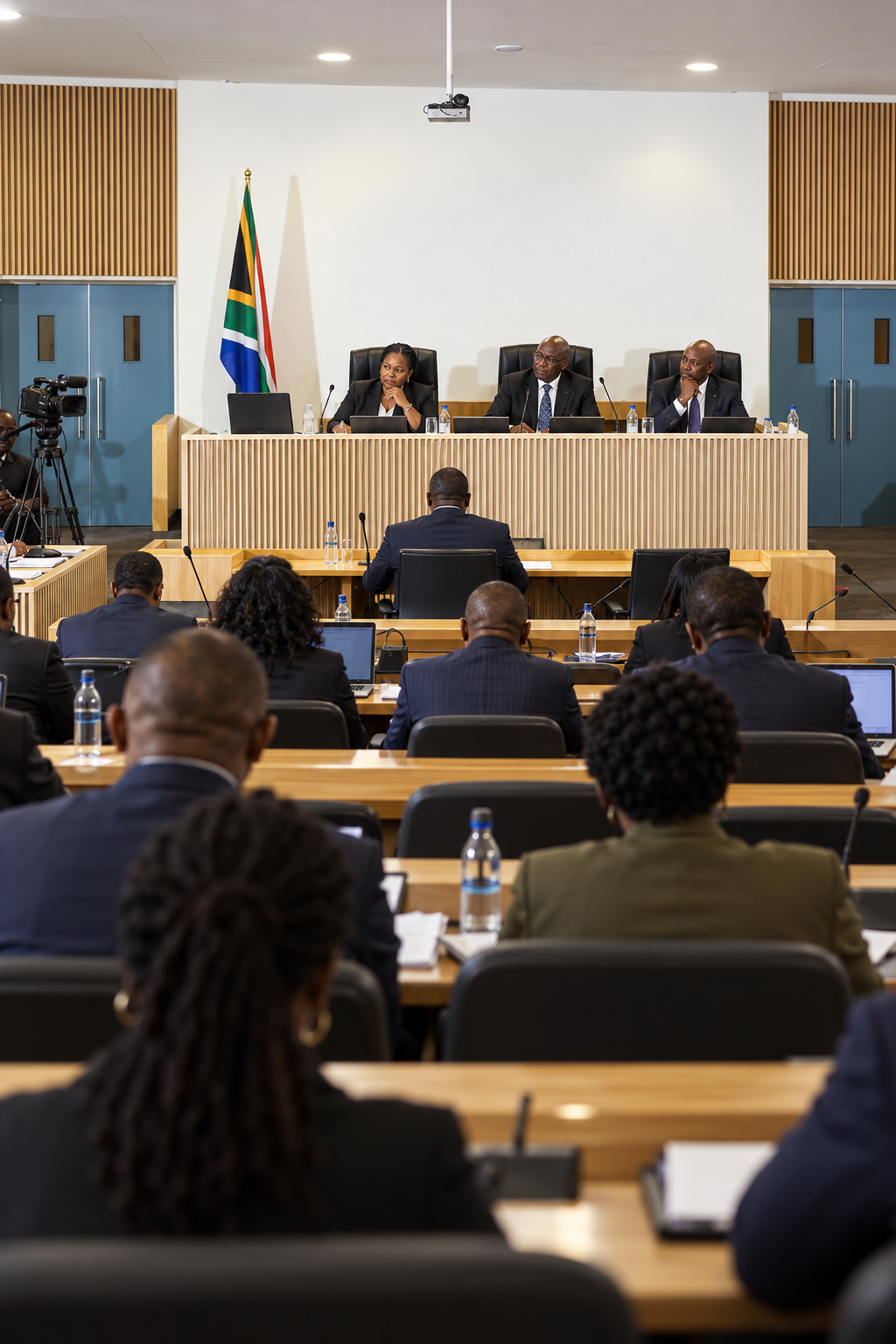
The
elevation of the national budgeting process into a terrain of opposition
politics, and by extension, the new node of economic transformation battles,
might be a welcome and overdue feature of the democratic order. Demystifying
the National Treasury as the be-all of fiscal policy and including the
legislatures in national revenue raising and allocation decisions is an overdue
frontier through which the economy becomes part of public discourse. The horse-trading,
and hopefully with ‘we the people’ at the centre, to get the Appropriation Bill
passed into an Act starts a new era.
The
spatial expression of the budget will hopefully become a window through which
the world of the marginalised poor is foregrounded. Parties to the GNU should
be evaluated based on how they are converting the National Budget into a stepping stone to growth and a bridge to dismantle the economic duality choking RSA. The
budget must be treated as one of the economic templates of dominance to be
reconfigured.
While
the debate about the budget is limited to the revenue-generating side of the
equation, public representatives need to realise the stalemate should be about
the underlying economic policy choices the budget is all about. The brute truth
is that fiscal policy, expressed through the budget, impacts the unemployment
rate. The budget should reflect how it deals with demographic
deficits, workforce skills, business needs, technology and automation, and the
efficiency of the labour market in matching people with jobs.
Without
eroding the now-at-risk credibility of monetary policy and the critical role
the Reserve Bank plays in targeting inflation and, by default, money supply,
the outcome of the 2024 electoral cycle might have created an opportunity for
inflation to be a more transparent public policy issue beyond the SARB Monetary
Policy Committee. These templates are the issue. CUT!!






Leave A Comment