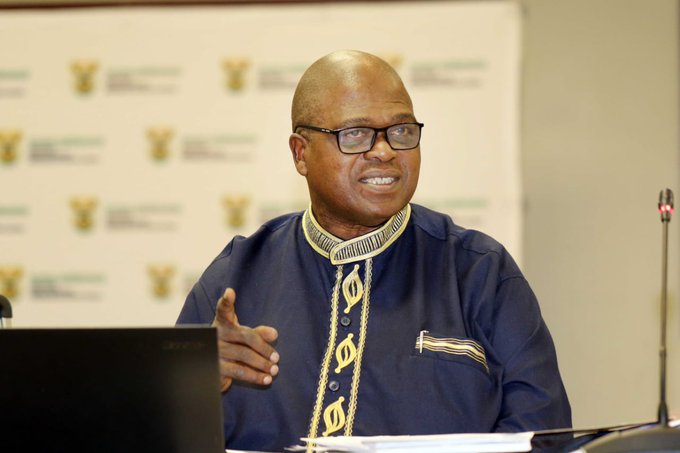
It is not the reality of Comrade Squire’s passing that unsettles us most. It is the lens through which we must now make sense of life without him.
A man larger than life, anchored by one of the most stable and rare internal loci of control, has left us. Death, in its familiar cruelty, has taken again.
Reading the notice bearing his image felt unreal. It was as though I could still call out to him, “O ya kae grootman, re sa go nyaka hierso.” And in that same moment, I could almost hear his response, “My Bla, mfanakithi, comrade Lucky, ere ko khutsa, mmele ga o sa kgona.” The quiet dialogue with him, even in his absence, and the memory of our private conversations, brought a strange solace, even as it demanded acceptance.
The news of his passing reveals something deeper. Death exposes what is buried within the living. In his absence, those who never heard him say “heita bla” will come to know what that greeting meant. It was not casual. It was recognition. It was “I see you.” Sawubona.
His voice, that distinct blend of soprano, alto, and hoarseness, is now silent. If death is not the end of life, then he now exists in another realm, with its own obligations beyond our reach.
A reader of classics, he would perhaps have borrowed from Charles Dickens and reminded us: never close your lips to those to whom you have opened your heart. He would have urged us to remember the people for whom we have given our lives.
His withdrawal from social media left a silence that is now more deeply felt. There is a noticeable absence where his thoughts once lived.
In Comrade Squire, we learned that the purpose of humanity is not merely to prepare for death, but to release as much life as possible before it arrives. His life carried both length and depth. It now lingers as a melody, one we listened to for as long as we were allowed. He becomes part of that permanence we call history.
He was a warrior for social and economic justice. His commitment inspired those around him, even when the outcomes he fought for remained incomplete.
Embedded within the narratives of the anti-apartheid struggle, he stands among the unsung figures behind the formation of the United Democratic Front. Only those willing to write truthfully will capture his contribution. History does not leave blank pages.
He lived many lives in one. A unionist, a public service commissioner, a senior bureaucrat, a political educator, a civic leader, and an underground operative of uMkhonto we Sizwe. Beyond all titles, he was a brother, a father, and a husband, steadfast to the end.
He was a leader of a particular kind. Not one defined by formal structures, but one rooted in relationships. He built deep, authentic connections across all levels of society. He influenced power not by holding office, but by shaping those who did. He was a minister through ministers, a premier through premiers, and, in many ways, a president through presidents.
He recognised potential where others saw roughness. He shaped individuals into leaders. In a place like Mamelodi, often burdened by negative narratives, he remains a story of possibility and pride.
The health system failed him.
While death may appear as a moment, for those who understood what he endured, it represents a deeper failure. A failure that speaks to the fragility of systems meant to sustain life.
Death, in its biological sense, is the body’s systems shutting down. In his case, it was also the health system, including its insurance structures, that ultimately said, “we can’t.”
The system does not account for history or contribution. It responds according to rigid frameworks. When private healthcare resources are exhausted, individuals are left to a public system that continues to struggle with capacity and delivery.
His passing exposes these realities. It forces us to confront what is often hidden. It asks what might have been possible if the system had functioned differently. There is a sense that more life remained, more to be given.
As we reflect, death reveals not only loss but responsibility. It exposes what was within our control, what could have been extended, and what must be improved.
With heavy hearts, we say farewell.
There is no shame in grief. It is, as Charles Dickens once wrote, like rain upon the dust of the earth, softening what has hardened within us.
With Comrade Squire, it was the best of times, sometimes the worst, always an age of wisdom, occasionally one of folly, a constant tension between belief and doubt, light and darkness, hope and its absence. Now, in his absence, we confront the quiet weight of loss.
A baobab has fallen. The impact is felt deeply. The loss is profound.
To his family, may you find comfort in knowing that he remains with us, held in memory and in spirit.
Lala ngoxolo, Big Man. Hamba kahle, Mkhonto we Sizwe. Sharp, Bra Squire. Your courage and your thoughts will be missed.
uZimu a ni tjhudubaze, Mtungwa.




Leave A Comment