Why South Africans must vote in the national interest when they choose their municipal governments on 4 November 2026
South Africa’s local government elections cannot be reduced to potholes, refuse collection or ward personalities. Municipalities govern land, infrastructure, energy systems, procurement, and investment decisions that organise the political economy. The ballot that chooses a council therefore does more than reward or punish local performance: it allocates control over strategic platforms of state power.
This is especially true of the eight metropolitan municipalities. Johannesburg, Tshwane, Ekurhuleni, eThekwini, Cape Town, Nelson Mandela Bay, Buffalo City and Mangaung are not merely large councils. Together they concentrate population, municipal revenue, transport networks, universities, industrial capacity, financial services, diplomatic presence and much of the country’s economic infrastructure. They are developmental nodes whose policy choices reverberate across Southern Africa. A contest for their governments is consequently also a contest over the direction, resilience and external alignment of the South African state.
Local government is constitutional power.
South Africa is one sovereign democratic state, but it experiences that sovereignty through three distinctive, interdependent and interrelated spheres of government. The Constitution does not treat municipalities as administrative outposts of Pretoria or as delivery agents operating by national delegation. Each sphere has original constitutional status, defined powers and a direct democratic constituency. Cooperative government binds the spheres together; it does not erase their distinctiveness.
That constitutional design makes every municipal council a meaningful site of state power. Across 257 councils, decisions are taken on spatial planning, land-use management, water, sanitation, electricity distribution, roads, waste, rates, tariffs and local economic development. These are not politically neutral functions. They shape who can invest, where communities can live, which firms gain access to infrastructure, how urban growth is financed, and whether public assets serve broad development or narrow accumulation.
The local state is therefore an economic gatekeeper. It issues permits, procures goods and services, regulates development, maintains the urban commons and determines the reliability of the infrastructure on which workers and businesses depend. In a mineral-rich country at Southern Africa’s logistical centre, authority over these functions inevitably attracts actors whose interests reach far beyond municipal boundaries.
Brazil’s warning: local results reorder national power
Brazil’s 2024 municipal elections illustrate the phenomenon without supplying a template for South Africa. About 154 million people were eligible to vote for mayors, deputy mayors and councillors across 5,570 municipalities. The final distribution of mayoralties favoured the political centre and centre-right: the Social Democratic Party (PSD) won 891, the Brazilian Democratic Movement (MDB) 863 and the Progressives (PP) 752. President Luiz Inácio Lula da Silva’s Workers’ Party (PT) won 252. The result consolidated centrist and conservative forces territorially, not a simple far-right sweep.
The lesson is not that municipal elections mechanically predict national outcomes. Local personalities, incumbency, and regional bargaining strongly shaped Brazil’s campaigns. But municipal victories build the infrastructure of national power: officeholders, budgets, party organisation, public visibility and coalition leverage. Brazil’s results therefore strengthened the centre-right ahead of the 2026 presidential contest without proving that any one national candidate would inherit the municipal vote.
São Paulo made the point visible. On 27 October 2024, incumbent mayor Ricardo Nunes (MDB) was re-elected with 59.35% of valid votes, defeating Guilherme Boulos (PSOL), who received 40.65%. Nunes led a broad coalition spanning the centre and right, while Lula endorsed Boulos. The race became a national test of political strength. Still, its outcome also shaped the Bolsonaro-versus-Lula story: a broad centre-right coalition was the principal beneficiary, while candidates more closely aligned with Bolsonaro’s harder line underperformed in several major cities.
The South African contest must remain South African
South Africa should read Brazil comparatively, not imitatively. Our constitutional order, party system, liberation history, social structure, and developmental crisis differ. Yet both countries are large, unequal democracies in the Global South; both have powerful cities whose local governments shape national political trajectories; and both operate in a world where transnational capital, ideological networks, and competing geopolitical centres closely watch domestic electoral outcomes.
The issue is not international engagement. Municipalities need investment, technology, climate finance and partnerships. The democratic risk arises when opaque funding, vendor dependence, policy conditionalities or information campaigns narrow local choices and convert municipal distress into external leverage. The test is straightforward: does a partnership expand public capacity and policy autonomy, or trade them away for short-term relief?
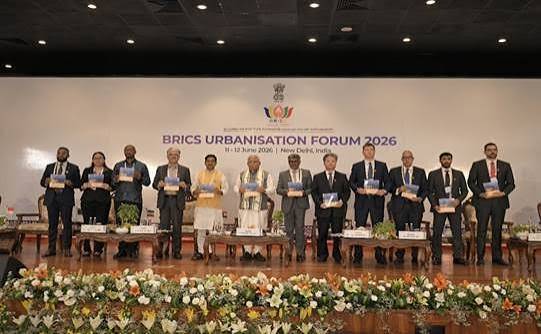
Municipal election outcomes can also reverberate through multilateral urban governance. A council cannot withdraw South Africa from BRICS, which remains a state-to-state formation, but new political leadership can redirect a city’s diplomacy: it can deepen, downgrade or abandon participation in BRICS urban forums, United Cities and Local Governments, climate coalitions, sister-city arrangements and development-finance networks. Across the eight metros, such shifts can cumulatively strengthen or weaken South Africa’s voice in global debates over urbanisation.
That diplomatic choice is not merely between East and West; it is also between competing models of urban development. A Global South paradigm centres informality, spatial redress, basic services, rapid population growth, climate justice and developmental infrastructure. Global North policy models often prioritise mature infrastructure renewal, high-cost decarbonisation, digital optimisation and private-finance-led development. If electoral turnover fragments South African cities across competing external networks, municipal diplomacy may pull against national strategy. Coordinated through cooperative government, however, it can translate local experience into influence within BRICS, the United Nations system and the wider global urban agenda.
Municipal dysfunction creates fertile ground for such capture. When taps run dry, power cuts deepen, sewage enters rivers, roads disintegrate, and billing systems collapse, citizens understandably seek immediate relief. Political entrepreneurs can then present wholesale ideological realignment as a technical rescue plan. Yet desperation must not suspend scrutiny. Voters should ask not only whether a party can repair a road, but whose developmental model it advances, who finances its political machinery, how it understands public assets and whether its coalition choices strengthen or weaken accountable government.
Coalitions can internationalise local vulnerability.
South Africa’s fragmented electoral landscape intensifies the stakes. In several metros, no party is likely to govern alone. Coalition negotiations conducted after the vote may therefore determine the real meaning of ballots cast before it. A party can campaign on one platform and then hand municipal authority to a coalition whose programme voters never clearly saw. This is not an argument against coalitions; they are a legitimate consequence of proportional representation. It is an argument for programmatic coalitions, public agreements, enforceable standards and consequences for opportunistic floor-crossing in all but name.
Where coalition governments repeatedly collapse, administrative continuity suffers, and unelected networks gain room to arbitrate between unstable political principals. Procurement, appointments, infrastructure planning, and revenue decisions then become vulnerable to deals concluded out of public view. The geopolitical risk does not always enter through dramatic foreign intervention. It may arrive indirectly through financing relationships, consultants, technology vendors, infrastructure concessions, data systems and local intermediaries who understand that a divided council is easier to influence than a coherent developmental state.
National-interest voting is not unquestioning party loyalty.
Insisting on national-interest-guided voting is not telling citizens to suspend judgement, excuse corruption, or reward parties for liberation credentials alone. National interest cannot be a slogan incumbents use to avoid accountability. It must have democratic and constitutional content: human dignity, equality, non-racialism, accountable government, social and economic inclusion, capable institutions, sustainable use of public resources, and sufficient policy autonomy for South Africa to pursue development in a contested world.
Voters should judge municipal contenders against at least five tests. Can they govern competently and ethically? Do they have a credible plan for revenue, maintenance and infrastructure? Will they publish their coalition commitments before or immediately after the election? Are their funding and strategic relationships transparent? And does their programme strengthen South Africa’s developmental autonomy while remaining open to mutually beneficial international cooperation?
These questions are particularly urgent in the metros. Decisions on electricity trading, water infrastructure, public transport, housing, broadband, waste-to-energy projects, ports and industrial land can bind a city to long-term financial and technological arrangements. A weak council may sign away strategic flexibility for immediate relief. A capable council can structure partnerships that bring investment while preserving public value, transparency and democratic control.
What is at stake on 4 November 2026
Wednesday, 4 November 2026 is the formally proclaimed election day. South Africans will elect the councils that govern the country’s municipalities. The immediate questions are local—water, electricity, refuse, roads and liveable neighbourhoods—but the cumulative result will be national. It will redistribute party strength, shape coalition blocs, develop future leaders and determine who controls institutions through which billions of rand in public spending and private investment are mediated.
Brazil’s 2024 results sharpen the warning. Municipal elections can reorder national bargaining power without being miniature presidential elections. Parties, investors, and diplomatic actors will likewise watch South Africa’s eight metros because control of them confers money, visibility, organisational reach, and influence over strategic infrastructure.
The answer is democratic vigilance, not conspiracy. Voters should demand credible candidates, transparent funding, costed service-delivery plans and public coalition agreements. They should reject both municipal decay defended in the name of history and dependency marketed as modernisation.
On 4 November, voters must refuse the false choice between competent service delivery and national sovereignty: South Africa needs both. Before marking the ballot, every citizen should ask three questions: can this party govern with integrity, will it protect public assets and public value, and can it enter coalitions and partnerships without surrendering South Africa’s freedom to choose its own developmental path? Do not vote only against failure; vote for a council capable of building, maintaining and defending the public realm. A vote cast for a ward and a municipality will also shape the architecture of national power. The ballot box is geopolitical—but its ultimate authority must remain, unmistakably and decisively, in the hands of the South African people.







Leave A Comment