
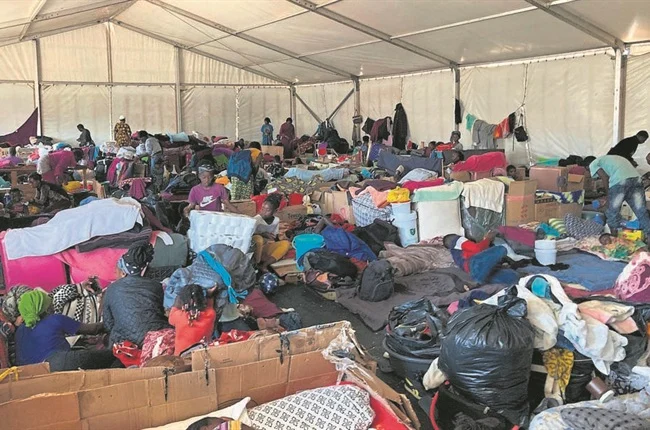
South Africa’s migration debate is not a choice between open borders and coercive sovereignty. It tests whether a developmental state can regulate belonging, protect scarce public goods, and uphold human dignity without letting incapacity harden into exclusion or authority descend into arbitrariness.
Introduction: A constitutional test disguised as a migration crisis
The intensifying controversy over migration—especially the social and legal consequences of being documented, undocumented, displaced or stateless—has placed the South African constitutional order under unusual strain. It has exposed failures that no single institution can claim alone. Parliament legislates, the executive administers, municipalities absorb the immediate pressures, the police enforce, and the courts review. Yet the lived experience is often a state acting in fragments: one arm announces, another delays, a third litigates, while communities and migrants face the consequences on the ground.
This institutional disarticulation reveals the essay’s central paradox. South Africa is at once a human-rights democracy, a sovereign state and an aspirant developmental state. Each identity creates an obligation that cannot be discharged in isolation. A human-rights democracy must protect the inherent dignity of every person subject to its power. A sovereign state must decide who enters, who remains and on what legal basis. A developmental state must direct finite resources toward the redress of citizens historically dispossessed by colonialism and apartheid.
Yet each obligation becomes self-defeating when pursued without the others. Rights without effective administration become paper guarantees; sovereignty without rights becomes coercion; and development that ignores lawful migration governance converts scarcity into social conflict. The paradox is therefore constitutive, not incidental: the state must exclude lawfully without dehumanising, include humanely without dissolving citizenship, and develop materially without making foreign nationals the explanation for failures of governance.
The Constitution does not require the state to choose between legality and humanity. It requires the state to exercise legality humanely, rationally, and accountably. Nor does it abolish citizenship as a meaningful constitutional status. It distinguishes certain political rights reserved for citizens from many fundamental protections extended to “everyone”. That distinction is not a drafting accident. It reflects a constitutional order in which membership matters, but personhood precedes membership when the state exercises coercive power.
“We, the people” and the meaning of belonging
The democratic promise will always be intertwined with democratic peril. South Africans rightly expect the gains of liberation to accrue, in material and political terms, to those historically dispossessed by colonialism and apartheid. But democratic citizenship’s legal obligations begin with submitting to the Constitution’s supremacy and the rule of law. Citizenship cannot mean that the law protects “us” only when protection is convenient, while exposing “them” to arbitrary power. Once arbitrariness is normalised at the margins, it rarely remains there.
The will of the people is therefore not a free-floating claim available to whichever constituency speaks most forcefully. In a constitutional democracy, popular will is organised through elections, representative institutions, public participation and procedures that require more than momentary majorities for foundational change. The Constitution does not displace democratic will; it gives that will an enduring institutional form while protecting it from capture by the loudest, the strongest or the temporarily dominant.
Freedom becomes secure when citizens fear its loss not only for themselves, but also when it is first taken from another person. The strongest evidence that a constitutional order protects its primary beneficiaries is its capacity to remain principled when dealing with those who are politically weak, administratively invisible or socially unpopular. A mature love of freedom is measured by how seriously it regards others’ freedom.
The phrase “South Africa belongs to all who live in it” should therefore neither be stripped of its emancipatory force nor be turned into an argument that borders, citizenship, and immigration law are constitutionally irrelevant. It is a founding political commitment against racial ownership of the country. It does not automatically confer citizenship on every resident, erase lawful distinctions between categories of persons or relieve the state of its duty to administer migration. Its deeper meaning is that public power may not reproduce systems of domination by declaring some human beings beyond dignity or lawful protection.
The developmental-state dilemma
Structural inequality sharpens the South African dilemma. This society is marked by unemployment, spatial exclusion, strained municipal services, and an economy long dependent on cheap, vulnerable labour. In such conditions, migration is easily narrated as a competition between poor citizens and poor non-citizens. That narrative is politically potent because it attaches a visible outsider to failures whose causes are often institutional, economic and historical.
Foreign nationals do affect labour markets, housing, schools, clinics and local economies; denying this prevents serious policy. Yet the scale and character of that impact cannot be understood apart from employer conduct, documentary backlogs, weak labour inspection, porous administrative systems, corruption and failures of intergovernmental planning. An undocumented worker is vulnerable not only because of immigration status, but because that status can be converted into a business model: lower wages, unsafe conditions and diminished bargaining power. The result harms citizens and migrants alike by degrading the labour floor.
A developmental state cannot answer this problem through moralism on one side or vigilantism on the other. It must possess administrative intelligence: credible data, timely status determination, coordination of the national and local consequences of migration, enforcement of labour standards, prosecution of trafficking and document fraud, and lawful, procedurally fair removal.
Here the paradox becomes an institutional test. The weaker the administration, the louder the demand for indiscriminate coercion; yet such coercion further weakens lawful authority by driving people beyond documentation, oversight and accountability. Conversely, a rights discourse detached from administrative consequences can leave vulnerable communities carrying burdens that the state has neither measured nor planned for.
Rights without administration become promises without institutional form; administration without rights becomes organised arbitrariness. A developmental state succeeds only when capacity and restraint grow together.
The judiciary’s dilemma: authority without administration
Yet administrative capacity alone does not resolve the paradox, because the Constitution subjects every assertion of state competence to review. The judiciary therefore occupies a particularly difficult position within this architecture. Section 165 vests the Republic’s judicial authority in independent courts, subject only to the Constitution and the law.
The courts are thus entrusted with the final constitutional discipline of public power. Yet judicial authority is not executive command. Courts do not patrol borders, process permits, operate reception offices, allocate municipal budgets or design labour-market policy. They adjudicate the legality of what the political branches do—or fail to do—while depending on those same branches to convert judgments into administrative reality.
Migration disputes therefore place courts at the intersection of competing constitutional interests. They must protect dignity, equality, liberty, procedural fairness and access to justice, including where foreign nationals invoke rights extended to “everyone”. At the same time, they cannot disregard the state’s legitimate authority to regulate entry and residence, safeguard public order, administer finite resources and honour the special constitutional status of citizenship. The judicial task is not to declare one set of interests morally pure and the other constitutionally suspect. It is to determine whether distinctions are authorised by law, rationally connected to a legitimate purpose, proportionate in their effects and implemented through fair procedures.
This role attracts criticism from opposite directions. An order restraining unlawful detention, deportation or exclusion may be portrayed as judicial indifference to sovereignty and public frustration. An order upholding a lawful regulatory distinction may be condemned as a retreat from transformative constitutionalism. But the courts’ obligation is neither to govern by public anger nor to erase policy choices entrusted to elected institutions. It is to insist that every exercise of coercive power remains constitutionally justified.
Their dilemma is sharpened when executive incapacity forces recurring litigation. Adjudication can correct an unlawful decision, but it cannot by itself repair a dysfunctional migration system. Persistent institutional failure risks turning courts into substitute administrators, while hostile political rhetoric risks treating constitutional review as an obstacle to governance rather than one of its conditions.
The proper judicial posture is therefore one of principled balance, not institutional timidity or policy substitution. Courts should afford the political branches space to formulate migration policy, but require that policy to remain faithful to legality, reasonableness and the Bill of Rights. They must remain attentive both to the vulnerability of foreign nationals and to the collective interests of the society in which those rights are claimed.
The judiciary thus inhabits the paradox in its purest institutional form. It must restrain the state sufficiently to prevent power from becoming arbitrary, yet avoid restraining it so completely that government cannot discharge its lawful responsibilities. This is not a compromise between rights and governance. It is the constitutional method by which authority is made governable, governance acquires legitimacy, and rights are reconciled with the claims of an organised political community.
Constitutional review should consequently not be cast as the judiciary frustrating the people’s will. The democratic choice was not merely to elect governments, but to establish a constitutional order in which Parliament, the executive and the courts exercise distinct forms of public authority under a common law of restraint. Judicial independence protects that settlement by ensuring that even institutions with electoral mandates remain answerable to the constitutional terms on which authority was conferred.
A principled state is not a permissive state.
That constitutional discipline points to a proposition easily obscured in polarised debate: a principled state is not a permissive state. South Africa must reject the false choice between “open borders” and collective punishment. The state may regulate entry, residence and naturalisation. It may distinguish among citizens, permanent residents, refugees, asylum seekers, temporary migrants and undocumented persons where the law permits and the distinction is rational.
It may also protect the integrity of its social and economic institutions. But it may not treat administrative status as a licence for humiliation, violence, collective exclusion or the suspension of due process. The paradox endures: authority is necessary, but it becomes defensible only when legality and dignity discipline it.
International law does not dissolve this tension; it gives it a wider constitutional frame. Under section 231 of the Constitution, treaties bind the Republic internationally and, when incorporated into domestic law, shape how the law treats foreign nationals. Section 233, in turn, favours interpretations consistent with international law.
The 1951 Refugee Convention and its 1967 Protocol, the OAU Refugee Convention, the African Charter, and universal instruments such as the ICCPR, ICESCR, Convention against Torture and Convention on the Rights of the Child do not place every non-citizen in the same legal position. They require differentiated protection for permanent residents, documented workers and students, visitors, refugees, asylum seekers, trafficking victims, unaccompanied children, undocumented migrants and stateless persons.
That differentiation is where principle must become administration. Refugees and qualifying asylum seekers engage protection against refoulement and require fair, timely status determination. Lawful temporary residents require predictable renewal, change-of-status or departure procedures. Permanent residents may pursue the rights and, where eligible, naturalisation pathways recognised in domestic law.
Trafficking victims and children require protection responsive to exploitation, vulnerability and the child’s best interests. Undocumented migrants remain entitled to dignity, due process and protection from torture or arbitrary detention. Still, they may face regularisation where law and policy permit, assisted or voluntary return, or lawful removal after individualised procedures.
Stateless persons, for their part, require identification, documentation, and access to durable legal status, even when gaps in treaty accession or domestic procedure leave protection incomplete.
The same paradox therefore assumes a different form in each legal category. For refugees, protection from return to persecution limits sovereignty to preserve its constitutional legitimacy. For documented migrants, predictable administration protects both lawful mobility and the integrity of the permit system. For undocumented persons, due process constrains coercion without extinguishing the possibility of removal.
For children, trafficking victims and stateless persons, vulnerability demands heightened protection without erasing the need for status, documentation and durable solutions. The state must neither convert international protection into an indiscriminate right to remain nor invoke sovereignty to strip treaty commitments of practical effect.
Its defensible course lies in category-sensitive administration, credible documentation, regional cooperation, lawful pathways to protection and residence, and procedurally fair return or removal. This is the paradox properly governed: compassion disciplined by law, control legitimised by rights, and international obligation translated into differentiated domestic action.
But even a coherent legal architecture will fail if the state continues to operate as a collection of disconnected institutions. The state administers migration nationally, while communities experience its social effects locally. Municipalities confront informal-settlement pressures, trading disputes, service demands and community tensions, often without timely information or adequate fiscal planning.
Provinces carry major responsibilities for health and education, while national departments control borders, identity systems, policing, labour regulation and international obligations. Cooperative government is therefore not an administrative afterthought; it is the means by which constitutional principle acquires territorial and institutional coherence.
Unless these spheres share data, clarify mandates and plan jointly, fragmentation will continue to masquerade as policy. Incapacity will continue to feed the very exclusionary politics that constitutional statecraft is meant to overcome.
Conclusion: From exclusionary politics to constitutional statecraft
The politics of exclusion draws its creative energy from fear: fear of unemployment, displacement, cultural loss, crime and the arbitrary distribution of scarce public goods. Some of these fears are grounded in lived experience; others are manipulated by actors who benefit when institutional failure is translated into hostility toward outsiders. A democratic state cannot answer fear by dismissing it. It must disaggregate it, test its claims, address its material causes and prevent it from becoming a justification for unlawful conduct.
The real paradox, therefore, is not that South Africa is both a human-rights democracy and a developmental state. Neither project can survive without the other’s discipline. Human rights without a capable state are declarations awaiting implementation; state capacity without human rights is power awaiting abuse.
Development without lawful migration governance intensifies scarcity and resentment. Migration control without developmental justice mistakes the outsider for the cause of institutional failure. Sovereignty is diminished both when borders cannot be administered and when they are administered arbitrarily.
The measure of constitutional statecraft is not whether South Africa chooses citizens over foreign nationals, compassion over control, or courts over elected government. It is whether the Republic can protect citizenship without degrading personhood, exercise control without normalising cruelty, honour international obligations without surrendering lawful differentiation, and build capacity without escaping constitutional restraint.
In this account, majority rule and constitutional supremacy are not rival principles. The majority may govern and mobilise for constitutional change, but it may not convert electoral authority into unlimited permission to dominate. Those who seek a different constitutional settlement must undertake the demanding work of persuasion, organisation, public participation and institutionally authorised amendment. That discipline is not an obstacle to the will of the people; it is what distinguishes democratic will from political assertion.
The future of South African freedom will be judged by whether the state can become strong enough to govern migration and principled enough not to be governed by fear.
Recommended reading
African National Congress. 1943. Africans’ Claims in South Africa. Adopted at the ANC Annual Conference, Bloemfontein, 16 December.
African National Congress. 1955. The Freedom Charter. Adopted at the Congress of the People, Kliptown, 26 June.
African Union. 1969. OAU Convention Governing the Specific Aspects of Refugee Problems in Africa. Addis Ababa: African Union.
Anjofui, P. 2025. A review of South Africa’s migration policy: Issues and policy recommendations. Open Research Africa, 8:17.
Constitutional Court of South Africa. 1996. Certification of the Constitution of the Republic of South Africa, 1996 (CCT 23/96), judgment delivered 6 September 1996.
Constitutional Court of South Africa. 1996. Certification of the Amended Text of the Constitution of the Republic of South Africa, 1996 (CCT 37/96), judgment delivered 4 December 1996.
Crush, J. 2001. Immigration, xenophobia and human rights in South Africa. Migration Policy Series No. 22. Cape Town: Southern African Migration Programme and South African Human Rights Commission.
Crush, J., Chikanda, A. & Skinner, C. (eds.). 2015. Mean streets: Migration, xenophobia and informality in South Africa. Ottawa: International Development Research Centre.
Ferim, V.B., Shai, K. & Fonkem, M. 2026. Editorial: Migration, identity, citizenship and conflict in the globalized world. Frontiers in Human Dynamics, 8:1808768.
Hani, C. 1991. Press conference remarks on constitutional democracy, judicial independence and accountable government, United States, April 1991. Archival audiovisual recording.
Hirsch, A. 2024. South Africa country study: Migration trends, policy, implementation, and outcomes. Johannesburg: New South Institute.
Khan, F. & Schreier, T. (eds.). 2023. Refugee law in South Africa. 2nd ed. Cape Town: Juta.
Khan, F. 2020. Does the right to dignity extend equally to refugees in South Africa? African Human Rights Law Journal, 20(1):261–284.
Klaaren, J. 2017. From prohibited immigrants to citizens: The origins of citizenship and nationality in South Africa. Cape Town: UCT Press.
Landau, L.B. (ed.). 2012. Exorcising the demons within: Xenophobia, violence and statecraft in contemporary South Africa. Johannesburg: Wits University Press.
Mandela, N.R. 1994. State of the Nation Address, Houses of Parliament, Cape Town, 24 May.
Maserumule, M.H. 2007. Reflections on South Africa as a developmental state. Journal of Public Administration, 42(3):211–219.
Mathebula, F.M.L. 2023. South African public administration: Who is the public in public administration? Administratio Publica.
Matshakaile, T.N. 2014. Access to justice for non-citizens: A constitutional analysis. Master’s dissertation. Stellenbosch: Stellenbosch University.
Mufamadi, A. 2026. Afrophobia—South Africa’s migration crisis is a governance crisis. Daily Maverick, 21 July.
Ndletyana, M. 2025. Strong institutions key to calming debate on undocumented immigrants. iReport South Africa, 11 September.
Oyebamiji, S.I., Kariuki, P., Adisa, O. & Oso, A.O. 2026. The role of law and courts in migration politics in South Africa: Insights, challenges, and lessons. Journal of Law, Society and Development, 13.
Pizzocri, C. 2026. Dignity is SA’s constitutional inheritance, not its weakness. Daily Maverick, 14 June.
Republic of South Africa. 1996. Constitution of the Republic of South Africa, 1996. Pretoria: Government Printer.
Republic of South Africa. 1998. Refugees Act 130 of 1998, as amended. Pretoria: Government Printer.
Republic of South Africa. 2002. Immigration Act 13 of 2002, as amended. Pretoria: Government Printer.
Roomanay, S. 2026. South Africa’s crisis of state authority and when citizens begin deporting people. Mail & Guardian, 26 June.
Segatti, A. & Landau, L.B. (eds.). 2011. Contemporary migration to South Africa: A regional development issue. Washington, DC: World Bank.
Shai, K.B. & Mothibi, K.A. 2015. Describing pre-2009 xenophobic violence in South Africa: A human-rights perspective. In: M.J. Mafukata (ed.), The xenophobic attacks in South Africa: Reflections and possible strategies.
South African History Online. 2019. Chapter 13: The public participation process. Constitutional Assembly archive.
Sunday Times Editorial. n.d.-a. Asylum ruling: The distortions and vigilantism are shameful. Sunday Times.
Sunday Times Editorial. n.d.-b. The African Union’s rejection of the “inherently xenophobic” label is welcome. Sunday Times.
Sunday Times Editorial. n.d.-c. The delicate balance between refugee rights and the limits of hospitality. Sunday Times.
United Nations High Commissioner for Refugees. 2020. Statelessness in Southern Africa: An overview. Geneva: UNHCR.
United Nations High Commissioner for Refugees. 2024. Statelessness policy brief. Geneva: UNHCR.
United Nations. 1951. Convention Relating to the Status of Refugees. Geneva: United Nations.
United Nations. 1967. Protocol Relating to the Status of Refugees. New York: United Nations.
Vilakazi, J. 2026. ConCourt faces crucial test in Parliament–Ramaphosa showdown. eNCA, 5 August.
Vil-Nkomo, S. 2013. The future of the public service: A political economy approach. Journal of Public Administration, 48(3):455–465.







Leave A Comment