
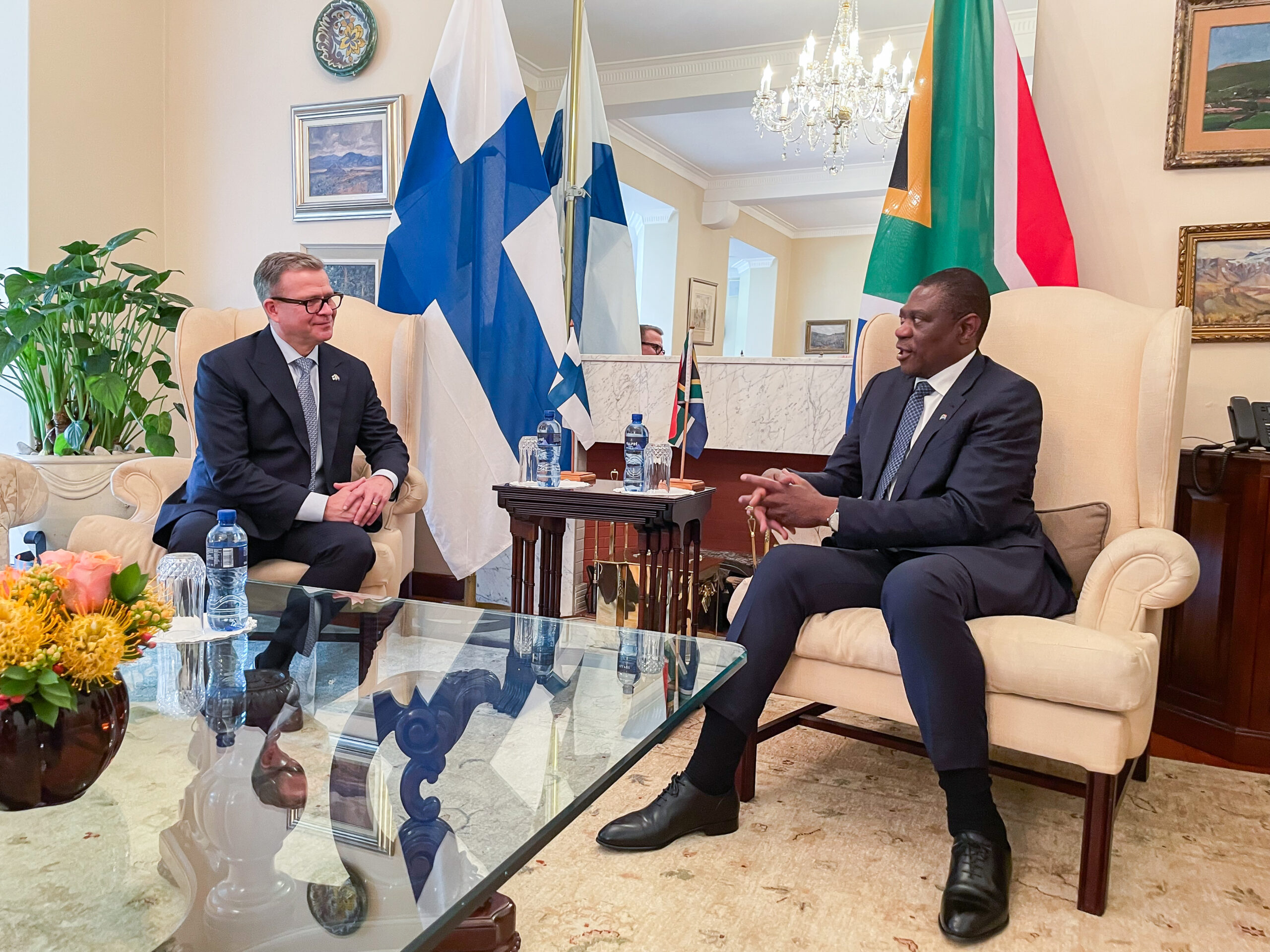
In December 2027, South Africa will confirm who will be the ANC’s candidate for the presidency, potentially the country’s chief jockey. Despite the race not being officially open, the main horses are on the racetrack, recording serious qualification times, distances, and weights. It is indisputable that the Deputy President, unless he does a David Mabuza and declares himself unavailable, is increasingly taking advantage of the air and stage time to demonstrate his fitness to run the race. This race will shape South Africa’s political future and influence policy directions.
Unless you are politically naïve, the rising prominence of Paul Mashatile as the heir apparent stems from a sophisticated, well-managed public relations campaign. Unlike his two predecessors, whose principals were significant obstacles, President Ramaphosa has thus far focused on his term and left succession matters to the process. It is for Paul Mashatile to lose the race to those who still need to prove they have what it takes; the momentum of convention is on his side.
The 2027 ANC elective conference comes hot on the heels of the highly contested local government elections. The contest is for about 10,000 councillor positions in 4,488 municipal wards. These wards are mirroring branches of political parties, particularly the ANC. This means the ANC would, in less than fifteen months from its most intensive mobilisation, the local government elections, go into its own succession of Ramaphosa’s elective conference. The outcome of these elections will directly impact the leadership race and the party’s future direction.
Given the pattern of shrinking voter support since 2016, which culminated in the catastrophic 2024 performance of less than 45%, the decline in voter numbers has resulted in fewer councillor positions. To some, a public representative role is their employment, and thus a matter of survival. The contest to become a conference delegate and influence the 2027 outcome will, by default, be the next most contested role.
Suppose the allegations of delegate buying are true. In that case, the 2027 opportunity to serve as a delegate might be a new frontier for those who rely on money to win ANC elective conferences. This factor alone changes the character of the 2027 ANC Conference, including all other sub-national conferences building up towards it. Recognising this potential influence is crucial for understanding the race’s dynamics and integrity.
In this turbulence, the two-horse race between Patrice Motsepe and Paul Mashatile is gaining political pixels in high definition, as the rest of the president wannabes enter a phase of opacity. The delay in resolving this matter is that, as a society, we will not know what they stand for as individuals until we are close to an otherwise compromised internal process within the ANC leadership selection, if previous court records are our evidence. The time has arrived to make what the ANC stands for an omnipresent force, with its leadership as the enduring
catalyst.
In the past three decades, and arguably since its founding in 1912, the ANC, as an organisation, cannot be doubted for having the best policies South Africa needs. It is inarguable that the ANC advanced the idea that the legitimacy of government authority rests on the will of ‘we the people. Becoming a liberation promise-guaranteeing party is the new challenge for the ANC. South Africa needs leadership to translate its post-1990 to 1996 gains, entrenched in the Constitution, into meaningful gains for its people. This requires neither struggle nor revolution, but pragmatic leadership driven by measurable outputs and outcomes.
The entry of Patrice Motsepe as a stronger candidate, on par with an otherwise Deputy President who is occupying and advantaging Paul Mashatile, creates a balance in the contest, unless the often-understated but grossly divided women’s vote gets organised to put up a formidable and long-overdue fight. The emerging two-horse race makes the two contenders peers from two distinct fields of social capital influence. One in the business world and the other in the political world. It is the completion of the political, social, and economic capital triangle that will make one of them go through 2027 and, potentially, by default, the consequential 2029 whole-of-state power-defining elections.
If leading the ANC was the only criterion for becoming its President, Paul Mashatile would enjoy varied advantages. Not least amongst them is having led the most sophisticated of ANC provinces, Gauteng. He has been the longest-serving chairperson of the most fluid and cosmopolitan provinces, the melting pot of ANCness. Historically, the influence of Paul Mashatile, stemming from his pre-1994 roles, covers most of the old Transvaal, which encompasses present-day Limpopo, Northwest, Mpumalanga, and Gauteng. This translates to four of the nine provinces being significantly influential.
If other criteria, especially the capacity to reverse the less than 45% catastrophic performance in 2024, the accumulated social reach of Patrice Motsepe is a reality no political power-chasing party can ignore. In fact, if he can announce his entry before the local government elections and be part of the election machinery, the fortunes might change. With COSATU and SACP being doubtful starters and yet key components of the ANC’s election juggernaut, Patrice Motsepe and his influence can change the course of history.
It is doubtful that Paul Mashatile can appeal to South Africans outside the ANC’s traditional support base. His success beyond the 2027 hurdle — which should be the highest standard — might depend on the ANC anchoring its succession choices more firmly in securing state power and attracting votes in the 2029 election. The disintegrating tripartite alliance, the diminishing space to claim a monopoly over the liberation struggle, and a large youth vote uninterested in struggle history demand a fresh perspective on how the ANC presents its
leadership candidates.
The era of boilerplate rhetoric and politics is over. South African society is keenly aware of the ANC’s use of various rhetorical strategies to deter its political adversaries. This has amplified its influence and masked its internal weaknesses. The moral high ground it maintains in international justice is gradually being matched by its commitments to domestic social and economic justice; the imbalance in its commitments is concerning. This is a point worth noting as it manages its succession journey.





Leave A Comment