On Mandela Day, memory invites us not only to honour Nelson Mandela as a global icon, but also to ask what his presence meant in the lives of ordinary people who encountered him at close range. For me, that meaning is captured in a handshake. It was brief, almost ordinary in its physical form, yet profound in what it carried: the touch of a man whose personal greatness had become inseparable from the collective courage of a generation and the moral possibility of a country struggling to be born anew.
In 1993, the Mamelodi ANC branch, in which I served as Deputy Secretary, decided to invite Nelson Mandela to address a rally. It would be his first visit to Pretoria’s largest township, a place with deep political memory and one historically associated with many MK operatives. The visit was therefore never simply an event on a political calendar. It was an encounter between Mandela and a community that had carried its own share of sacrifice, defiance and hope.
The last time a Mandela had come to Mamelodi with such emotional and political appeal was when Winnie Mandela attended the mass burial of the victims of the 21 November Mamelodi Massacre, among them my classmate and softball captain, Moses Motsei. Against that background, the branch executive decided that I would serve as programme director at the rally. In effect, I would be the host-in-chief of an occasion that carried the weight of history.
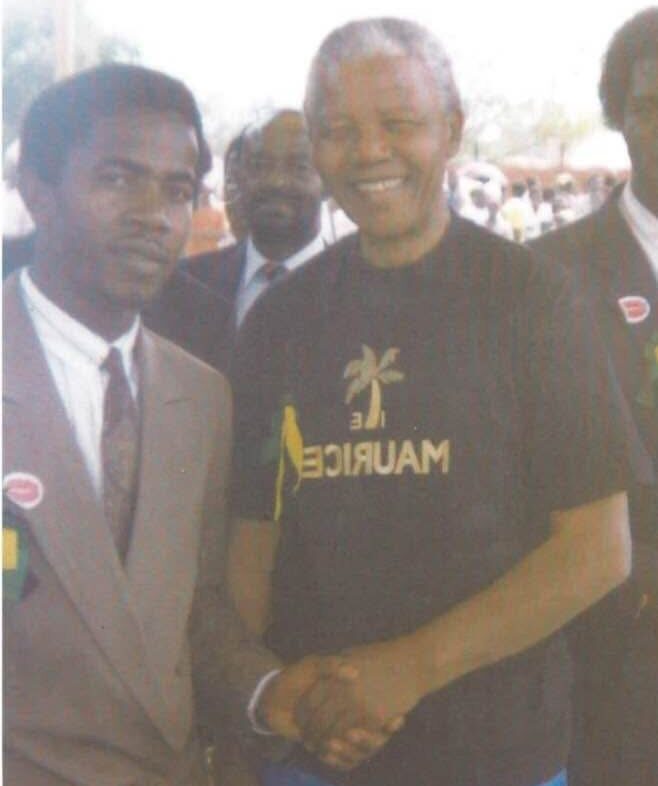
When Nelson Mandela arrived at HM Pitje Stadium, then still functional and alive with the energy of public mobilisation, he came to honour his appointment with the people of Mamelodi. Yet for me, the defining moment was not only the speech, the crowd, or the symbolism of his presence. It was the personal encounter: the handshake through which Mandela ceased to be only a distant figure of struggle and became, however briefly, a touchable human being.
That handshake was not my first encounter with him. The first had been telephonic, during a tense moment when, as the Mamelodi Teachers Union, we had asked school principals to leave “our schools” because we regarded their presence as an extension of the regime we were resisting. ANC headquarters sent a delegation to Mamelodi to order that the principals return to school. When the delegation arrived, I was called into Mr Laka’s office to take a phone call. On the other side of the line was Nelson Mandela. The conversation lasted less than three minutes. His instruction was clear: the principals must return. That call changed the calculus of the meeting, and the instruction was carried out.
But the handshake at HM Pitje Stadium carried a different kind of meaning. It represented validation: of my decision to join the liberation struggle, of the many roles I had chosen to play, and of the discipline required to see every space of engagement as a platform for advancing the values we believed the ANC embodied. In that moment, Mandela was demystified without being diminished. He remained great, but his greatness became human, reachable and demanding.
By the time we voted in 1994, Mandela had become the clearest embodiment of a nation trying to recognise the injustices of the past while working to heal them. His presence helped redefine, for many of us, what it meant to be South African. The handshake had anticipated that lesson in miniature: that dignity is not an abstraction, that reconciliation must be embodied, and that justice must eventually be felt in the lives of people. His legacy of fighting for human dignity, social and economic justice, and a country in which all would be equal before the law remains a lodestar.
On this Mandela Day, I remember that handshake not as a private keepsake alone, but as a reminder of the ethical burden of leadership. For Mandela, integrity was never decorative; it governed trust, disciplined power and secured the liberation promise from becoming a disruptive force against itself. Such was the depth of that touch. Whoever Mandela recognised as a person of integrity became, for me, a measure of the kind of people with whom one could build. The handshake still speaks: greatness is meaningful only when it restores dignity, summons responsibility and leaves others more committed to serve.
Yet Mandela Day also asks hard questions of the movement that carried Mandela into history and of the country that inherited his democratic promise. The ANC’s renewal must become a moral handshake with the future: clean governance, ethical leadership, humility before citizens, and the courage to place South Africa above organisational entitlement. As Thabo Mbeki has warned, renewal is owed not merely to a party line, but to the people; the ANC must live up to the promises it makes.
Barack Obama captured the responsibility of the present when he reflected that “every generation has the opportunity to remake the world.” Ours must be a handshake with truth over denial, accountability over impunity, service over privilege, competence over mediocrity, and hope over cynicism. If Mandela’s handshake affirmed the dignity of those who served the struggle, our handshake with the future must affirm the dignity of those still waiting for democracy to work in their lives.
On Mandela Day, let us extend the handshake forward—not as ceremony, but as commitment. Let us commit to dignity where there is neglect, service where there is need, accountability where there has been impunity, and hope where cynicism has taken root. Mandela’s handshake belongs to history; what we do with our hands now belongs to the future.


Leave A Comment