

When hidden networks manufacture political inevitability, democracy becomes a contest over who owns the state.
The contest to succeed President Cyril Ramaphosa is about more than the ambitions of individual leaders within the African National Congress. It is also a struggle among political, economic, and increasingly criminal networks seeking to shape who may legitimately govern and whose interests the state will ultimately serve. The growing promotion of Patrice Motsepe as a possible future president therefore demands scrutiny not only of the candidate, but also of the forces constructing his political inevitability. This article examines that contest as a battle of Establishments and asks whether South Africa’s democratic institutions can prevent organised networks from converting influence over the state into ownership of it.
The Establishment and the Manufacture of Political Choice
South Africa’s next president will not be chosen by voters alone. Long before citizens cast their ballots, powerful networks begin shaping which leaders appear credible, capable and inevitable. Politics describes such a network as the Establishment: “the dominant social group, the élite, who control a polity, an organisation, or an institution”. In the praxis of power, it is usually a self-selecting, closed élite entrenched within particular institutions, allowing a relatively small social class to exercise extensive socio-political control.
If there were ever doubt that South Africa has a sophisticated Establishment, one need only consider how Patrice Motsepe is being received as the country’s next President and potential heir apparent. Motsepe represents, even if he could legitimately deny it, the dominant, secret and unauthorised power network operating independently of the state’s above-ground political leadership in pursuit of a consensus in which many of us have no part.
Despite the political mandate that politicians receive from the public, these networks, which have constituted themselves as a deep state, have for some time succeeded in manipulating the public state. In South Africa, they have managed to ensure that government continues to display the characteristics of one based on the people’s will, while drawing its legitimacy from how sophisticatedly it advances the interests of the Establishment.
Consequently, this has pitted the dominant network against any unknown and ascendant network. In this rendition, that condition is called the battle of Establishments. All families, institutions and organisations have Establishments, either self-funded or funded by larger Establishments pursuing their own or geopolitical interests. The stakes become graver, however, when these networks do not merely influence political choice but recruit criminal power to penetrate and redirect the institutions of the state.
When Establishment Power Turns Criminal
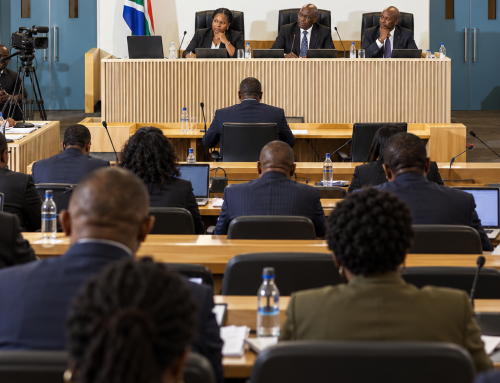
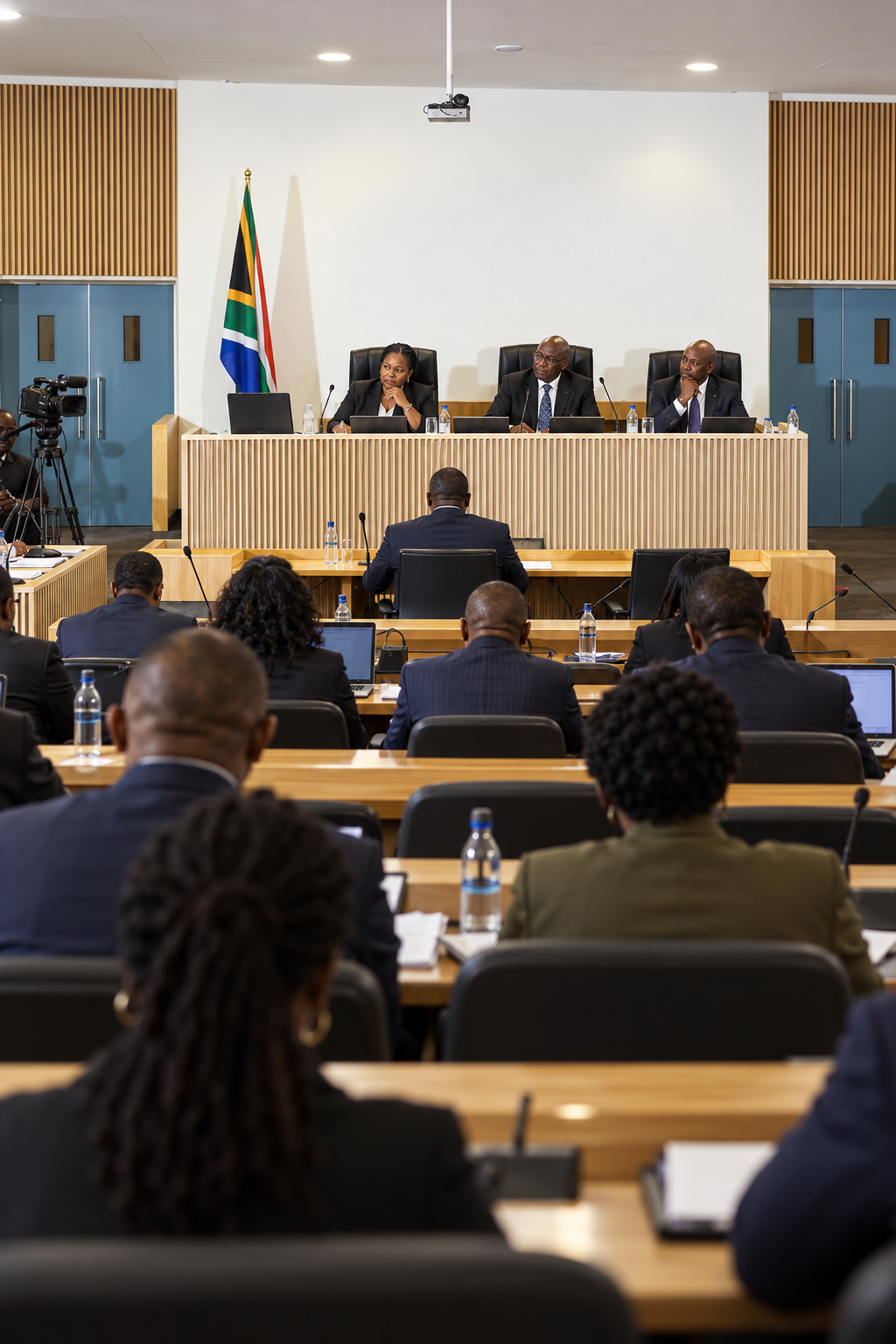
It is at this point that the evidence emerging before the Madlanga Commission gives the battle of Establishments a more dangerous meaning. It points to the alleged infiltration of the criminal justice system by criminal syndicates and to the possibility that a criminal underworld Establishment has sought to capture instruments of state power for private protection, enrichment and influence. Where such networks privilege members of their own in-group—effectively reproducing a tribal logic of loyalty and exclusion—the contest is no longer simply between political or economic élites; it becomes a struggle over whether public authority will serve the constitutional order or a criminal fraternity. The balance between competing Establishments must therefore be managed through democratic scrutiny, institutional integrity and the rule of law, so that no network—political, economic or criminal—can convert access to the state into ownership of it. Yet criminal infiltration is only the most visible form of capture; a comparable danger arises when an influential liberation movement itself becomes the vehicle through which hidden interests seek control of the state.
The Capture of a Liberation Movement
Unlike ZANU-PF, the African National Congress has never featured in plans for a global regime-change stratagem. Its international and national brand power, and the diverse interests represented by its internal Establishments, have instead made it a candidate for “liberation movement capture”. For South Africa, the plan seems always to have been to take over the ANC or its influential personalities and repurpose it or them to achieve what regime change would ordinarily have achieved elsewhere. As President Mbeki once declared, “it is too big to collapse”, yet very cheap, in cost terms, to control.
The ANC’s propensity to rally behind personalities has narrowed the scope for capturing it, though the methods have become no less sophisticated. Few centres exist through which it can be bought for a cause. If you cannot purchase the delegates to its National Conference, you can fund a narrative to undermine the leadership and policy direction agreed upon by the Conference. That vulnerability makes the programme attached to any emerging presidential personality—not merely the personality itself—the central democratic question.
What Does Motsepe Stand For?
Against this background, what Patrice Motsepe stands for, although not a showstopper for his bid, still needs to be clarified. This should be articulated as the reason he became the face of what some faceless narrative or Establishment wants. Because we now think of our democracy as a state of actual equality, in which every opinion is as good as any other on almost any subject under the sun, we are easily blinded by narratives that might derail our pursuit of what is in the National Interest. The economic Establishment, disguised within private-sector nodes of economic-transformation narratives and targeting persons of the ilk represented by Patrice’s history, is itself a means of short-circuiting democracy.
This is because the objectives of a stable democracy in any society depend on the public understanding the implications of its own choices, and Patrice Motsepe appears to be the choice this narrative wants. The necessary response is therefore to move the debate from the appeal of the individual to the substance of the programme offered in his name.
From Personality to Programme
That shift from personality to programme should begin with the PM27 campaign, which has attracted the endearment of the leading platform of the pro-Patrice narrative, News24, articulating what drives it. PM27 should now invest in explaining what about Patrice, beyond his struggle history and billionaire profile, is worth defending in policy terms. South Africa has endured political phases centred on defending a person, with consequences that leave much to be desired. The time has come to neutralise this obsession with individuals. The pragmatism that Patrice has historically displayed should offer an opportunity to make South Africa’s leadership issue-driven; this trait defines Motsepe’s personal journey. The ANC has a battery of policies and Conference resolutions around which PM27 can anchor its campaign. If Patrice does not define his agenda, responding to his critics can easily become his agenda.
What is comforting is that the narrative in favour of Patrice, which is also about his inner circle, has not yet produced the proverbial “smallanyana skeletons”. This can only mean that his inner circle comprises network nodes of what the Establishment wants around state power. Without the benefit of knowing what lies within the pro-Motsepe narrative, society is presented with claims amounting to little more than “Patrice is the new path”, without the nation being taken into confidence about “wat eintlik gaan hier aan?” This lack of clarity does not remain an abstract concern: it directly shapes the alliances, rivalries and ruptures through which the succession contest is now unfolding.
Succession and the Contest for the Political Order
Seen in this light, it is undeniable that one objective of the pro-Patrice narrative is to rupture the relationship between him and his standing-by-convention rival, Paul Mashatile, thereby creating dysfunction within a potentially ascendant new Establishment. In short, this is a battle for inclusion in the Political Order within which the journey to Patrice’s present position was built.
Otherwise, the battle can persuasively be understood as resistance to the emergence of a new Political Order. Either way, Motsepe has now become a natural node of contestation. Besides him, and the convention-determined ANC Deputy President, Paul Mashatile, only a credible woman candidate can emerge as an alternative to the discontent-defined narratives, whether true or false, about the incumbent, President Ramaphosa. Beneath these succession manoeuvres lies a deeper democratic issue: how trust is manufactured, and how the boundaries of acceptable political choice are set.
Democracy, Trust and the New Tribalism
This brings the argument back to democracy and trust. At issue is the emphasis on making Establishment-approved politicians appear capable and trustworthy. As Benjamin Ho summed it up in his book Why Trust Matters, “The line that I remember most from my own studies in political science is that the most important indicator of the strength of a democracy is not the set of things that people vote on, but instead the set of things that people are not allowed to vote on.”
Since 1912, ANCness has been defined by the struggle against tribalism. Yet a new tribalism is emerging, disguised as the defence of freedoms for which society fought and expressed through networks that reserve power, protection and opportunity for their own. Whether the Establishment is political, economic or criminal, the democratic danger is the same: public authority is gradually converted into the private property of an organised few.
South Africa’s next president must therefore not be manufactured as inevitable by forces operating beyond public scrutiny. Motsepe, and every other contender, must be judged not by the wealth, media influence or networks assembled behind them, but by the programme they openly place before the ANC and the country. The decisive question is not which Establishment wins the contest for the state, but whether democratic institutions are strong enough to prevent any Establishment from owning it. If the ANC allows hidden networks to determine the boundaries of political choice, it will not merely have chosen a leader; it will have surrendered its historic mission to a new tribe.






Thank you for informative article..