
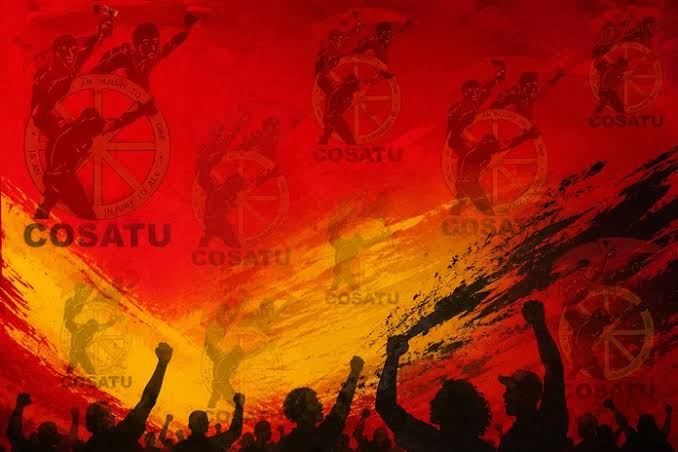
“He is a dreamer; let us leave him: pass” Julius Caesar.
Every political formation has its appointed hour: a moment when accumulated contradictions stop being background noise and become the sound of an approaching rupture. For the Tripartite Alliance, that hour may well be 2029. The warning signs are not hidden. They are visible in electoral decline, organisational drift, ideological exhaustion and the slow corrosion of trust between the governing party, organised labour and the left. The question is no longer whether the Alliance is under strain. Still, what specific political, economic, and social consequences will follow if it collapses, and how could this destabilise South Africa’s broader stability?
The soothsayer at the gate
In Shakespeare’s Julius Caesar, the warning to “beware the Ides of March” is not merely prophecy. It is a political alarm bell. It announces the day on which an emperor is betrayed by those closest to him, stabbed in the back by trusted hands, and left as a bleeding sign that Rome would not be the same again. The prize was power; the price was chaos.
That is the tragedy of political ambition when it ferments without principle: it becomes a cocktail whose only possible result is catastrophe. Caesar’s corpse was not simply a body on the floor. It warned that once the centre is pierced, the empire begins to tremble.
In much the same way, Africa’s foremost and most formidable ideological and political coalition — the Tripartite Alliance of the ANC, the SACP and COSATU — is passing through its own danger zone. The soothsayers are no longer outside the gates. They are inside the assemblies, murmuring, manoeuvring and, in some cases, working towards the Ides of 2029.
As momentum towards 2029 builds, loyalists of the historic Alliance continue to speak the optimistic language of the National Democratic Revolution, as if repetition can substitute for renewal. But dogma, when clung to despite society’s feedback, becomes a veil over reality. The electorate has been sending message after message since 2016. The Alliance must recognise these signals to inspire hope for meaningful renewal, not just slogans.
Like Caesar walking towards the Senate despite warning signs, the Alliance moves forward by misreading, misrepresenting or deliberately ignoring the objective situation. It has failed to reckon honestly with national and geopolitical changes, such as regional power shifts or international economic pressures, that could hasten or delay its collapse. Since the democratic breakthrough of 1994, its politics have been a fragile ensemble — capable, at any moment, of lurching into chaos because of an accumulation of factors, forces and factions.
The Constitution and the mortal journey
When the 1996 Constitution was certified as the basis of South Africa’s democratic and constitutional order, the Alliance entered a new and mortal journey. The conditions of legality hollowed out the ideological focus that was held together by the normative appeal of a post-apartheid possibility and the establishment of a National Democratic Society. The essence of the constitutional order, its provisions, and normative thrust bequeathed the ‘national assignment’ of the National Democratic Revolution to the State, notably its most active agent, the government of the day. Without a reconfigured focus on how to execute the NDR continuum, the Alliance’s mortality became entombed. It did not collapse immediately. Instead, it began to be worn away from within, gripped by an endemic crisis that waited for the right moment to tip over—like a syndrome spreading quietly through the entire organism.
The storm gets the blame; the termites did the work
The Alliance now resembles the proverbial tree that falls during a visible storm, not because the storm alone brought it down, but because termites had long been eating it from the inside. The storm gets the blame; the termites did the work.
Those termites are hard at work, turning the Ides of 2029 into a self-fulfilling prophecy. The journey began in earnest when the administrative centre and core nerve of the Alliance started showing signs of collapse, as three of its once-formidable secretaries were consumed by different crises.
The SACP lost Dr Blade Nzimande to Cabinet before it had sufficiently strengthened its succession processes. COSATU lost Zwelinzima Vavi and, by extension, an experienced Irvin Jim from its political secretariat at a time when its own succession arrangements were not ready for rupture. The ANC lost Ace Magashule and allowed the vacancy to drift until conference “filled” it — if the allegations of vote-buying raised by Nkosazana Dlamini-Zuma are anything to go by. The Alliance was for a while disabled not only by the ideological contestations and the infectious factionalism that manifested itself in varying degrees in each of its components, but also by the hollowing out of its historical succession rituals. The Alliance Political Council’s efficacy has arguably been compromised.
The consequential cracks of the General Secretaries’ turnover rate, the tensions between the ANC as governing party, the decisions on governing coalition arrangements, the expulsion of NUMSA, the formation of the MKP, and the Polokwane Conference fault lines that concretised themselves into the CR17 and CR22 versus NDZ17 and NDZ22 became institutional termites that settled and continue to eat the proverbial tree for the final storm to complete the process.
When the broad church becomes an establishment
Beyond the cracks in these critical administrative centres, the ideological fissures around South Africa’s economic direction were always likely to become a breeding ground for rupture. The ANC, as the broad church of the Alliance, was increasingly becoming a political establishment dominated by neoliberal orthodoxy. This was not merely a voluntary choice; it also reflected its changed mass character and its open-society-type membership.
The leftist substratum that once held the Alliance together was being forced into competition with the crass and material realities of governing in an extractive, mercantilist and capitalist economy. As the state became the economy, decisions on industrialisation and the commanding heights of development increasingly passed through ideology-deficient processes.
The demands of governing dictated a plethora of policy reframing by the ANC as governing party of both the employer and the worker, believer and atheist, capitalist and socialist, and ANC voter and opposition party voter. This framed Alliance partners as part of competitive arenas of scarce resources, competing interests, and struggles for power and advantage.
When policy forums become succession battlegrounds
The postponement of the 15th COSATU Conference must therefore be read as more than an organisational inconvenience. It is not yet clear what finally broke the camel’s back. But public-facing reports suggest the familiar cancer of turning critical policymaking forums into arenas for leadership contests rather than spaces for policy decisions. Ideological maturity and prudence would have dictated a different path: allow the conference to process policy direction, and postpone leadership questions to a later date. The dearth of revolutionary discourse has once again given way to the ascendance of breeds of lumpen conduct. Whoever possesses the advanced tools of analysis today, as the collapse drama has shown, is gradually, if not chronically, finding it harder to use revolutionary theory and easier to lose at the altar of the chaotic ensemble.
COSATU is not decorative infrastructure
COSATU is not the Alliance’s decorative surface; it is part of its historical infrastructure. At the height of its organisational prowess, organised labour helped liquidate apartheid at its core. Its affiliates’ capacity to use membership subscription liquidity to challenge encroaching hegemonies remains part of the superstructure from which the next phases of the National Democratic Revolution could be executed. In the wake of a politically power-shedding ANC, COSATU unions may yet need to study the Solidarity Union and Movement’s withdrawal into the laager as a masterclass in institutional self-preservation.
Society’s needs may now be treated as a version of the contemptuous language some ANC leaders have used to dismiss ordinary people; or, rather, as the worker’s anger that only an organised COSATU can muster and discipline into political force. It began with “clever blacks”, a phrase that helped push sections of the intelligentsia away from the liberation movement complex as active agents of change. It continued with the indiscriminate use of “leadership”, “my leader” and “comrade”, opening the liberation complex to the kinds of characters now parading before commissions and public scandal.
The tragedy is that a coterie of political players has replaced the centre. Each has some power, sponsored or otherwise, to shape ideological, political or governmental outcomes, but none has enough power to determine them alone. They hold different notions of working-class politics and remain bound to workers’ struggles more by shared history than by the ideological exigencies of the moment. That places a heavy responsibility on COSATU and its affiliates: to project themselves more deliberately into the National Democratic Revolution, especially its outstanding deliverables and demands. If they fail, the Ides of 2029 will not arrive as a surprise. It will arrive as the day everyone saw coming, while pretending not to hear the soothsayer at the gate.
Conclusion: before the daggers are drawn
The Alliance can still avoid turning 2029 into its own Ides of March. But avoidance will not come through nostalgia, slogans or ritual affirmations of unity. It will require the courage to name the termites, drain the cocktail of ambition without principle, and rebuild the centre before the empire begins to tremble beyond repair. COSATU, in particular, must decide whether it will remain a historical ornament in a fading liberation mural or reassert itself as a disciplined force capable of giving worker anger political direction. History rarely announces collapse with a single thunderclap. More often, it whispers through cracked institutions, postponed conferences, hollow phrases and warnings ignored at the gate. The tragedy of Rome was not that no one spoke. It was that those with power refused to listen. South Africa’s Alliance still has time to hear the warning, but not forever. The brute truth is that crises, especially in politics, are an acid test of leadership.




Thanks for your critical ‘termite’ pen analysis. Maybe the solution can be to Summon a Pest Control Specialist to fumigate the entire Body politik