The crisis over foreign nationals is not only a migration dispute. It is a warning that South Africa’s state is losing the ability to govern visibly, lawfully and competently where citizens feel most abandoned.
Introduction
South Africa’s migration flashpoints are not only about foreign nationals. They reveal a deeper crisis of state capability, citizenship clarity and democratic authority. As the Government of National Unity attempts to stabilise a fragmented political order, it must confront the harder question: whether government still governs where citizens experience abandonment most directly.
The Meaning of Governmental Emptiness
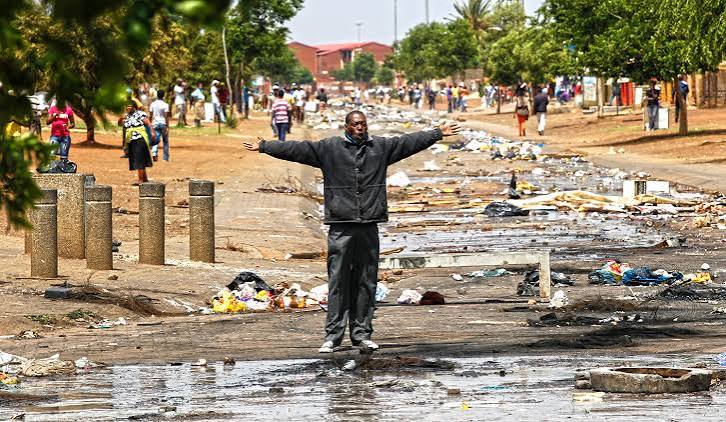
South Africa is not yet a failed state in the conventional sense. Its Constitution remains intact; elections are held; courts function; budgets are passed; ministers are appointed; and citizens still invoke the language of rights. Yet this formal architecture increasingly coexists with a harsher reality: in many communities, the state is present in name but absent in function. South Africa is becoming governmentally empty.
The phrase “governmentally empty” is deliberately unsettling. It does not describe a society without politicians, laws or institutions. It describes one in which governing structures exist but fail to function: a clinic without medicine, a school without sufficient instruction, a police station without order, a border without effective control, an immigration regime without dependable administration. The state has not vanished. It has become operationally thin.
This is the meaning of governmental emptiness: the citizen encounters the state as a promise, not as a working capability. Plans are tabled and mandates proclaimed, but at street level the outputs are meagre, uneven and often humiliating. The citizen still stands in a queue that does not move, travels to an office that cannot help, or watches informal forces take over functions that properly belong to the state.
Basic political science teaches that the state performs essential functions: national security, law and order, economic management, public services and social welfare. South Africa’s constitutional project added a higher democratic ambition: human dignity, equality, freedom, accountability, responsiveness and the improvement of life for all citizens. The Constitution is not decorative language. It is the moral compact through which “we, the people” constituted one sovereign democratic state.
The GNU as Test and Possible Catalyst
That compact is now under strain. The 2024 election, which denied any single party an outright mandate, produced the seventh democratic administration under President Cyril Ramaphosa and the Government of National Unity. Unlike the 1994 GNU, born of negotiated transition and national stabilisation, the 2024 GNU is a coalition of necessity. It must manage party differences while restoring the credibility of government itself.
This is where the GNU becomes decisive. It may either restore governing capability or deepen the emptiness it inherited. If it becomes an accommodation among parties, a mechanism for distributing offices and postponing hard decisions, it will accelerate the decay it was meant to arrest. It cannot be judged only by whether it survives. It must be judged by whether it makes government work where society most brutally experiences its absence.
Migration as the Mirror of State Absence
The crisis of foreign nationals in South Africa exposes this emptiness with unusual force. Migration has become the arena in which citizens experience the breakdown of state authority, administrative clarity and democratic trust. Communities are angry about unemployment, crime, informal trading, overburdened clinics, overcrowded schools and weak border management. Migrants, asylum seekers and refugees experience fear, exclusion and sometimes violence. The state appears as an unreliable referee: unable to enforce immigration law properly, process documentation efficiently, or distinguish consistently between lawful migration, asylum protection, undocumented presence and criminality.
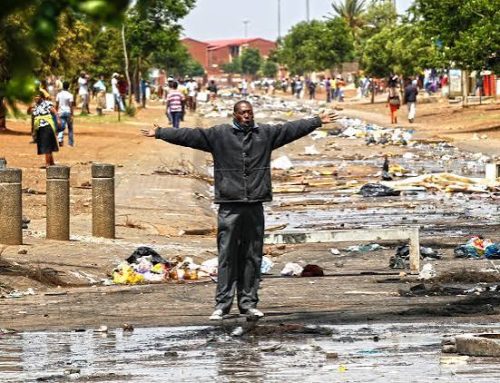
Into this vacuum step civic formations, vigilante groups and political entrepreneurs. When the state cannot visibly regulate who enters, stays, works, trades or accesses scarce public services, society begins to improvise. Improvisation then hardens into self-appointed enforcement. This is a dangerous democratic moment: a demand for order may express legitimate grievance, but when it abandons legality it threatens the constitutional order itself.
The recent targeting of foreign nationals at clinics and public facilities is therefore not merely an immigration issue. It is a symptom of governmental emptiness. It shows that sections of society no longer believe the state can decide, administer and enforce public rules fairly. Constitutional rights are now being contested at clinic entrances, in queues outside public offices, in informal trading spaces and in townships where the meaning of citizenship is no longer abstract. The question “who belongs?” has become inseparable from “who receives?”
Citizenship, Rights and Administrative Order
South Africa urgently needs conceptual and administrative clarity on citizenship. The constitutional declaration that South Africa belongs to all who live in it was a repudiation of racial exclusion, not a licence for administrative vagueness. A democratic state must protect human dignity and basic rights, including those of migrants, refugees and asylum seekers. But it must also define, defend and prioritise the rights and obligations of citizens. A state that cannot distinguish between a citizen, permanent resident, asylum seeker, refugee, lawful temporary migrant and undocumented person cannot govern migration honestly.
This distinction is not xenophobia. It is constitutional administration. Citizenship is the core membership of the democratic community: the basis for choosing government, holding office, claiming a sense of belonging, and demanding reciprocal duties from the state. Non-citizens also have rights, and a constitutional democracy cannot permit their humiliation or unlawful exclusion. But those rights do not abolish the need for a coherent citizenship regime. Rights without order produce resentment; order without rights produces authoritarianism.
The foreign national crisis has become combustible because the state has allowed different questions to collapse into one another. Illegal entry is not refuge from persecution. Poor border control is not the same as skilled migration that contributes to development. Pressure on clinics is not solved by civilians demanding identity documents at the gate. Crime committed by a foreign national is not proof of collective guilt. Equally, the existence of xenophobia does not mean citizens are inventing the pressures they experience. The challenge is to govern these distinctions, not evade them.
What the GNU Must Now Do
The GNU must therefore confront migration not as a public-relations irritation but as a test of state capability. Home Affairs, the Border Management Authority, the police, municipalities, labour inspectors, health authorities, education departments, and intelligence structures must function as a single coordinated system. Immigration administration requires credible registration, reliable documentation, lawful enforcement, efficient asylum processing, labour-market regulation, municipal planning, regional diplomacy and a development strategy that understands Southern Africa as an integrated human and economic space.
South Africa also needs an honest debate about transformation in this context. If transformation is a citizen-centric project of redress, inclusion, and capability-building, the state must know who is in the country, on what basis, with what rights and obligations, and what developmental contributions. If skills, investment, entrepreneurship and regional mobility are needed, lawful pathways must be designed. If undocumented migration is exploited by employers, criminal networks or corrupt officials, the state must act. If citizens believe they are being displaced from services, the state must produce facts, not slogans.
When Protest Becomes Substitute Government
The deeper problem is that South Africa’s rules of conflict are shifting. The liberation struggle produced resistance against an unjust state. Democracy promised to transform resistance into participation through elections, institutions, rights and service delivery. But when services collapse, protest returns as the dominant language of citizenship. In migration flashpoints, this disconnection becomes sharper because citizens see undocumented migrants not only as people in need, but as evidence that the state has lost control.
This does not legitimise vigilantism. No democratic society can allow private groups to decide who may enter a clinic, attend a school, trade in a street or remain in a community. The authority to verify identity, enforce immigration law, arrest, detain or deport belongs to the state and must be exercised lawfully. The cure for state failure cannot be social coercion masquerading as patriotism. Yet it is irresponsible to dismiss the anger behind these actions as mere prejudice. It grows in the soil of state incapacity.
The GNU’s responsibility is to restore the democratic connection in practical terms: when a citizen reports a crime and receives help; when a clinic has medicine; when a school teaches effectively; when a municipality repairs infrastructure; when a border is managed; when a visa application is processed fairly; when an asylum seeker receives a lawful decision; when an undocumented person is dealt with through due process; and when employers who exploit vulnerable migrants face consequences. Government must become a working presence, not a rumour.
The alternative is severe. A governmentally empty society does not remain empty for long. Vacuums are filled by gangs, vigilantes, patronage networks, demagogues, informal power brokers and local strongmen. The Constitution may remain formally supreme while becoming socially weak. People stop asking what the law provides and begin asking who can deliver immediate protection, access or punishment. That is how democratic legitimacy decays: not through one rupture, but through the normalisation of state absence.
Towards a Firm Democratic Settlement
For this reason, the GNU must reconsider transformation, citizenship and administrative capability together. It must stop treating policy as performance and start treating implementation as the essence of democracy. Transformation without a capable state becomes theatre. Constitutionalism without administration becomes rhetoric. Citizenship without enforceable membership breeds confusion. Migration policy without border control, documentation, and due process breeds conflict. Good governance is the process that keeps government and population bound to one another.
A firm migration settlement must rest on five propositions. South Africa must protect human dignity and reject xenophobic violence. Citizenship must be clarified as the primary political membership of the republic. Lawful migration must be facilitated where it advances development, skills, investment, regional cooperation and social stability. Undocumented migration must be addressed through lawful, efficient and humane enforcement, not mob action. Above all, the state must rebuild the administrative machinery that makes these distinctions real.
There is no contradiction between compassion and control. A serious state can protect refugees and enforce immigration law; welcome skills and punish illegality; prioritise citizens and respect non-citizens; secure borders and avoid cruelty. What it cannot do is drift. Drift permits opportunists to convert administrative failure into ethnic suspicion and civic anxiety into mobilisation against vulnerable people. Drift is what turns queues at clinics into theatres of national belonging.
Conclusion: Restore Government Before the Void Hardens
The foreign nationals crisis is therefore a warning about the South African state. It is not only about migrants. It is about whether democratic government still governs; whether the GNU can move beyond elite pact-making and restore capability where citizens experience abandonment; and whether “we, the people” can be translated into an administratively competent republic that knows who belongs, who is protected, who is admitted, who is documented, who is removed and who is accountable.
South Africa is approaching a decisive point. If the GNU fails to restore the functional state, society will continue to organise around the state’s absence. The legitimacy of protest will expand, but so too will the danger of coercive self-government. The country may not announce its failure. It may simply become accustomed to official incapacity and unofficial enforcement.
The task before the GNU is not only to hold parties together. It is to hold society and government together. It must restore the democratic connection before governmental emptiness becomes the defining condition of South African life. The republic does not need more declarations of concern. It needs a state that can act lawfully, competently and visibly. Without that, democracy will remain written in the Constitution while citizens, migrants and communities confront one another in the void left by government.





Leave A Comment