
“It is in your hands to make of our world a better one for all.” — Nelson Mandela
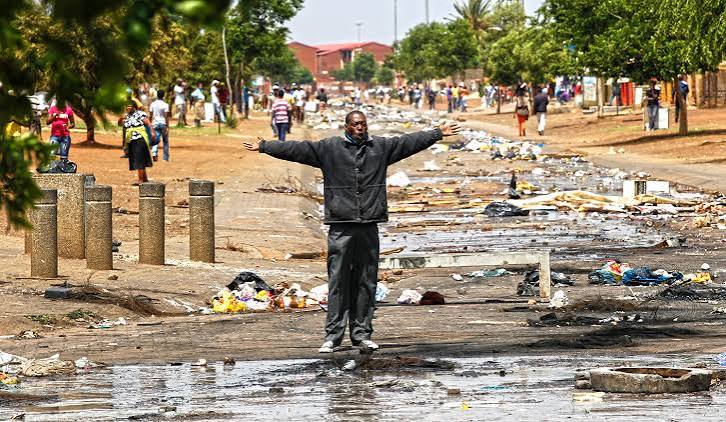
South Africa’s democracy is not collapsing in one dramatic gesture. It is fraying in the ordinary places where citizens first test whether the state still hears them: the ward office, the municipal account, the broken streetlight, the dry tap, the police station, the school, the clinic and the unanswered complaint. Constitutional rights remain intact, elections continue, and public institutions still speak the language of legality. Yet beneath that formal order lies a widening field of social injury: unemployment, collapsing services, criminalised politics, youth despair and a growing suspicion that democratic procedures have become too slow, too elite and too distant to carry the weight of lived grievance.
The danger is not grievance itself. Every serious democracy contains conflict. The danger lies in how grievance is organised. Civil strife becomes historically decisive when suffering finds interpreters, organisers and leaders. South Africa’s central question is therefore whether anger will be mediated through democratic institutions and civic discipline, or captured by forces that convert abandonment into militancy.
The post-apartheid settlement was never meant to be a minimalist democracy of procedures alone. Its ambition was social transformation. But rights do not organise themselves. They require institutions, money, lawyers, media platforms, civic infrastructure and moral language. Those with the resources to activate rights often do so more effectively than the poor can translate deprivation into power. The paradox lies not in the existence of rights, but in the unequal capacity to use them.
When politics fails to resolve distributive conflict, law is asked to carry more than it should. Courts remain essential guardians of legality, but they cannot replace democratic negotiation, developmental statecraft or social repair. Meanwhile, the state itself is increasingly experienced as a prize. Those inside it may confuse access with legitimacy; those outside it may see public office as the nearest available economy. In both cases, public power is emptied of civic purpose and refashioned as private opportunity.
That is where democratic patience begins to harden into anger. Unemployment, debt, insecurity, collapsing services and the daily humiliation of exclusion are producing new forms of radical politics. Anger is often politically intelligible. The danger is that it may become available to actors with no democratic ethic, no developmental programme and no interest in the republic beyond its usefulness as spoils.
Political violence, assassinations, intimidation and the maiming of civilians must therefore be read as more than criminality, even though they must be confronted as criminality. They are also symptoms of civic disintegration. A political elite that performs crass materialism teaches society that public office is an enterprise of accumulation. Once that lesson settles, trust thins, active citizenship becomes costly, and opportunists can present themselves as tribunes of the wounded.
Youth anger is the most volatile carrier of this unresolved tension. Young people are not inherently disorderly; they stand closest to the broken promise of democratic mobility. They possess rights, credentials, aspirations and political language, yet too many remain outside work, property, productive networks and meaningful recognition. They are invited to participate in democracy while being denied the economic standing that makes participation feel consequential.
Such anger is politically unstable. It can become civic, democratic and transformative, but it can also become criminal, xenophobic, militarised or patriarchal, depending on the institutions available to receive it. Where youth leagues are hollowed out, community organisations are weak, schools do not lead to livelihoods and party branches become factional machines, anger becomes politically homeless. In that homelessness, the street, the tavern, the taxi rank, the social-media platform, the gang and the local strongman become alternative schools of political identity.
This is why local government matters so profoundly. Municipalities are where constitutional promise becomes water in a tap, refuse removed from a street, electricity restored to a household, a road repaired or a councillor held accountable. They are also closest to contracts, land-use decisions, housing lists, jobs, and ward influence. The struggle over a council seat or municipal tender can therefore become, for some, the nearest available economy.
The coming local government elections should not be treated as routine municipal contests. They will test whether parties still have roots, whether civic formations can convert protest into accountability, whether coalitions can govern, and whether anger can be channelled through democratic institutions rather than intimidation. The road to 2029 begins in councils and wards, not only in Parliament.
The danger, then, is anger without democratic architecture. Democracies need young anger when it is morally disciplined, intellectually armed and institutionally channelled; without it, societies decay quietly. But when anger is severed from ethics, memory, organisation and programme, it becomes available to those who weaponise humiliation without transforming its causes.
A republic serious about survival must do more than pacify youth or lecture citizens about constitutional patience. It must organise people into work, service, production, learning, local reconstruction and democratic authorship. If South Africa fails to produce disciplined democratic leadership where citizens first meet the state, survivalist leaders will present themselves as rescuers.
That is the warning before the next municipal contest and the national realignment that may follow. The battle for local power is also a battle over the next democratic settlement. Civil strife searches for a leader when democratic leadership stops listening.






Leave A Comment