
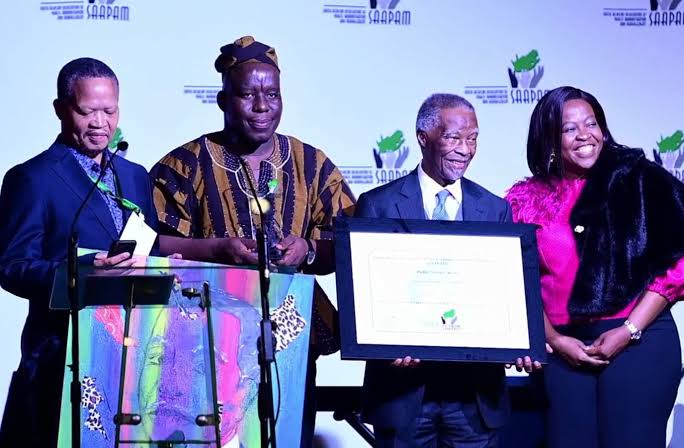
President Thabo Mbeki’s anniversary address offered SAAPAM more than praise: it challenged members to protect the Association’s intellectual integrity, professional standards, and developmental purpose, fostering pride and a shared sense of purpose among members.
An honour that also carried an obligation
At SAAPAM’s 25th anniversary—marking its institutional lineage as successor to the South African Institute of Public Administration (SAIPA)—President Thabo Mbeki became the inaugural recipient of the Association’s highest public service award. His acceptance was not merely ceremonial. Characteristically, he located the honour within a larger argument about institutional standing and public purpose: “It is the weight of SAAPAM in the award that made the acceptance of the award possible.”
For members, this was both an endorsement and a charge. To say that SAAPAM carries weight is to recognise it as an institution capable of shaping the ideas, standards and practices through which South Africa is governed. Membership therefore carries normative obligations: fidelity to the Constitution, service to the public interest, intellectual honesty, professional competence, ethical conduct and accountability to peers and society. Members should be prepared to test their assumptions against evidence, disclose conflicts of interest, resist partisan or private capture, and speak with courage when administrative action departs from law, ethics or developmental purpose. Institutional weight is never permanent; it must be earned repeatedly through the conduct of members, the quality of the Association’s scholarship and its willingness to defend the integrity of the profession.
Growth must not become dilution.
That obligation becomes more demanding as the Association grows. Institutions of SAAPAM’s kind will inevitably attract members whose prominence, ambitions or eventual influence their founders could not have anticipated. Mbeki warned that rapid membership growth can dilute the qualities required of a leadership institution. In an environment where liberated zones of intellectual engagement are scarce, and lumpen institutional cultures proliferate, an expanding professional body can become especially vulnerable to capture. Membership of a professional association does not, by itself, make one a professional. It creates an obligation to become one—and to remain accountable to the standards that the designation implies.
The answer is to measure growth by impact rather than scale, while ensuring that leadership selection rewards intellectual authority, ethical credibility and service to the profession rather than the arithmetic of votes alone. History shows that even institutions whose ideas once transformed global understandings of colonialism, racism and the meaning of freedom can lose their critical edge when electoral majorities become a substitute for principled leadership and institutional purpose. SAAPAM should therefore be judged not simply by the number of people on its membership register, but by its effect on public administration. The real tests are the quality and relevance of its knowledge outputs; the public conduct of its members; its contribution to stronger institutions; its protection of spaces for independent intellectual engagement; and its readiness to act when conduct brings the Association or the profession into disrepute. These measures distinguish a professional community from a credentialing network and provide its strongest defence against capture.
Giving content to the capable and ethical state
That distinction matters because SAAPAM’s professional standards must ultimately serve a larger public purpose: building a capable and ethical state. The Association’s intellectual fecundity—its ability to generate, test and circulate serious ideas—must help give form, content and character to that often-invoked ideal. Mbeki’s questions remain urgent: What is a capable state? What attributes define it? Can capability be separated from ethics? Who within the state must act ethically, and what does such ethical conduct require in practice?
Answering these questions requires more than conference themes or ceremonial declarations. It demands sustained research, professional formation and honest engagement with the everyday machinery of government. This is where SAAPAM’s role as a continuing professional development institution for the public service is essential. Through lifelong learning, peer exchange, research dissemination, and reflective practice, it helps public servants continually renew the knowledge, judgment, and ethical capacity needed in changing conditions. A capable state is not produced by proclamation. Public servants and scholars build it by understanding the constitutional purpose of administration, maintaining the competence to execute lawful policy and accepting responsibility for the consequences of their decisions.
That responsibility is most immediate for SAAPAM members serving in the public service. Public servants constitute the mind and operating intelligence of the state: they advise, formulate and translate political mandates into policy, programmes and administrative action. At their best, they can also serve as its institutional conscience. The public service and its organised professional formations should therefore be willing to ask difficult, evidence-based questions about the direction, coherence and consequences of state policy. In the present period, this includes using monitoring and evaluation not merely to record activities, but to assess how far the Government of National Unity has progressed in fulfilling the objectives set out in its Statement of Intent, where implementation is lagging and what corrective action is required to close the distance between declared commitments and citizens’ lived experience.
Resisting credentialism
Fulfilling that responsibility requires more than formal recognition. The professionalisation agenda can strengthen the state, but only if it is not reduced to certification. Qualifications, certificates and membership designations may attest to learning or affiliation, but they do not by themselves establish professional judgement, ethical courage or a commitment to public value. Professionalisation is a continuing discipline. It requires every SAAPAM member to keep their knowledge current, participate meaningfully in continuing professional development, submit their work to scrutiny, share knowledge with peers, mentor emerging practitioners, observe a defensible code of conduct, and place the constitutional duties of public administration above personal advancement, institutional convenience, or partisan loyalty.
For that reason, SAAPAM’s CPD function must not become a points-accumulation exercise. It should cultivate reflective practitioners who can connect theory to administrative realities, learn from failure and transfer improved practice across the state. If membership becomes attractive chiefly because it confers status, improves access to opportunities or supplies a marketable credential, SAAPAM risks admitting people who seek the benefits of professional recognition without accepting its obligations.
What begins as an individual pursuit of status can, over time, become an institutional danger. Once a professional body measures success primarily through membership volumes, revenue or influence, standards can be softened, misconduct tolerated and intellectual independence compromised. South Africa’s experience also shows how professional associations can drift into the posture of trade unions, patronage networks or platforms for ambitions unrelated to scholarship and professional service. SAAPAM must resist that drift. Its purpose is not to negotiate private advantage for members, protect them from legitimate accountability or become a gatekeeper for appointments. It is to cultivate a community of practice whose authority rests on demonstrated competence, ethical conduct, peer accountability and service to society.
Resisting that drift requires transparent admission criteria, substantive and accessible CPD, credible mechanisms for addressing misconduct and a culture in which members are prepared to challenge poor administration—even when doing so is uncomfortable. The value of SAAPAM membership should therefore lie not in the certificate displayed after one’s name, but in the standard of judgement, conduct, continuous learning and public contribution that the Association can reasonably expect from everyone who carries its name.
SAAPAM’s responsibility in the GNU era
Those standards now face a concrete test in the Government of National Unity era. The GNU presents SAAPAM with a defining professional responsibility. Its success cannot be assessed only through political accommodation or the durability of agreements among parties; it must ultimately be judged by whether the state becomes more capable, ethical, coherent and responsive to citizens. The public service is the mind and operating intelligence through which the GNU’s commitments must be translated into policy and implementation. SAAPAM should therefore help ensure that administrative practice remains anchored in the Constitution, lawful government policy and an ethic of service, rather than becoming fragmented by competing partisan interests.
The National Dialogue provides one arena in which to discharge that responsibility. This is the significance of Mbeki’s challenge: SAAPAM finds a distinctive role in the process. The Association should position itself as an independent, credible civil-society voice that translates societal frustrations about institutional failure, uneven service delivery, corruption, exclusion, and the gap between constitutional promise and lived reality into disciplined analysis and practical proposals. Its contribution should include sustained, evidence-based monitoring of how far the GNU has progressed towards the objectives in its Statement of Intent, where implementation is faltering, whether policy choices remain coherent and what corrective action is required.
To make that contribution credible, SAAPAM must neither become an adjunct of the GNU nor retreat into detached commentary. Its task is to bring professional knowledge, ethical courage and institutional memory to bear on the work of government; to ask difficult questions without partisan fear or favour; and to offer implementable alternatives where performance falls short. This responsibility begins with members themselves: they must sustain their competence through continuing professional development, act with constitutional fidelity, subject their judgements to evidence and peer scrutiny, share knowledge across institutional boundaries and accept accountability for the public consequences of their advice and decisions. By using CPD to renew ethics, learn policy, and improve administrative practice, SAAPAM can help the public service evaluate the GNU’s performance and respond intelligently to identified failures. If the Association combines intellectual independence with constructive engagement, it can help hold the GNU to its declared purposes while strengthening the administrative foundations of a capable and developmental state. That is how SAAPAM’s institutional weight—and the normative promise of membership—can become a source of public value in this new political era.











Leave A Comment