
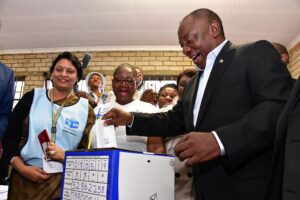
The concerns raised about corruption, inequality and democratic drift are legitimate and must be confronted with seriousness. However, the democratic mandate must not be abandoned; it must be honoured through accelerated reform, institutional rebuilding and the renewal of the ANC as an instrument of service to the people.
By Dr FM Lucky Mathebula[1]
Dear Comrade[2] Jay,
I have read Comrade Jay Naidoo’s open letter to President Cyril Ramaphosa, notwithstanding his decision to address the President in a manner that departs from the conventions of comradeship, with the seriousness it warrants. It is a letter grounded in struggle, memory, moral anxiety and concern for the condition of the Republic. The ANC does not, and must not, dismiss criticism from those who have travelled the long road of liberation with our people. However, respect for Comrade Jay’s contribution cannot require agreement where his diagnosis is partial and his proposed remedy risks weakening the democratic project that generations of South Africans fought to establish.
Comrade Jay is correct that the struggle was never for public office as an end in itself. It was for human dignity, social justice, democratic power and a better life for all. Corruption has undermined the movement’s standing and eroded public confidence. Municipal failure has imposed daily indignities on too many communities. Unemployment remains unacceptably high, and inequality continues to offend the nation’s conscience. The ANC cannot deny these realities. It must confront them with honesty, discipline and resolve, for a movement that refuses self-correction forfeits the moral authority to lead.
Where we differ fundamentally is in the contention that President Ramaphosa has been absent from leadership, or that the proper course is for him to surrender the democratic mandate because the state is presumed beyond repair. That proposition mistakes the arduous work of institutional reconstruction for inaction. It measures a presidency of recovery against the expectations of ordinary times and risks legitimising despair precisely when disciplined national renewal is required.
The ANC has never led in easy seasons. It led under illegality and exile, through mass mobilisation and underground organisation, and later through negotiations that carried South Africa away from apartheid and civil war into constitutional democracy. Nelson Mandela’s founding presidency gave the republic moral legitimacy, constitutional permanence and the ethic of reconciliation. Thabo Mbeki’s presidency deepened state-building, fiscal credibility, policy seriousness and African agency. Ramaphosa’s presidency must draw from both inheritances: Mandela’s constitutional calm and Mbeki’s institutional discipline.
Ramaphosa began not on clean ground, but amid institutional ruin: hollowed-out law-enforcement agencies, compromised state-owned enterprises, weakened revenue institutions, factional paralysis, a collapsing energy system, declining trust and an economy trapped in low growth. Then came Covid-19, the July 2021 unrest, global shocks, load-shedding, logistics failures, fiscal constraints and the first national coalition arrangement since 1994. These are not excuses. They are the terrain on which leadership has had to operate.
In this terrain, leadership cannot be assessed merely by the volume of public denunciation. It must be assessed by whether institutions are being restored, reforms are being institutionalised, the rule of law is being strengthened, investment and production are being unlocked, and the constitutional centre is being maintained under pressure. This is the demanding terrain on which the ANC must govern, organise and renew itself at the same time.
The fight against state capture has not moved at the pace citizens deserve, but it has not been abandoned. The Zondo Commission was not buried. Its findings have informed institutional and legal reform: the strengthening of the National Prosecuting Authority, the creation of a permanent Investigating Directorate Against Corruption, the rebuilding of SARS, procurement reform, anti-money-laundering measures and the recovery of stolen public funds. These are the hard foundations of a republic trying to ensure that state capture does not reproduce itself under new names.
The same is true of economic reform. Operation Vulindlela may not stir the crowd’s emotions, but it has become one of the most consequential instruments of statecraft in the democratic period. It has tackled binding constraints in electricity, logistics, water, telecommunications, visas and local government. The reduction in the severity and frequency of load-shedding did not happen by accident. It followed difficult decisions to open the electricity sector, enable private generation, begin restructuring Eskom and build a more competitive energy market.
The reform of ports and rail, the reduction of data costs, the modernisation of visa systems, and renewed attention to water and municipal functionality are not without limitations. They require scrutiny, contestation and improvement. Yet they constitute evidence of leadership that is institutional, programmatic and developmental, rather than rhetorical or theatrical.
Ramaphosa captured this reform logic in his 2022 State of the Nation Address when he called on the country to “forge a new consensus to confront a new reality, a consensus that unites us behind our shared determination to reform our economy and rebuild our institutions.” That formulation matters because it locates reform not as an abandonment of transformation, but as a condition for transforming the materially possible.
These reforms are not merely technocratic; they are social interventions through economic means. Energy reform keeps clinics open, schools functioning, small businesses trading and households protected from darkness. Logistics reform lowers costs, protects jobs and strengthens food security. Water, visa, digital, and municipal reforms restore the conditions under which enterprise, tourism, skills, infrastructure, and services can function. For an ANC member committed to transformation, the test is whether reform expands productive capacity, supports township and rural enterprise, creates work, improves public services and gives the state fiscal room to fund social justice. Transformation without growth becomes the redistribution of scarcity; growth without transformation reproduces old forms of exclusion.
This is also a question of social cohesion. A society where electricity fails, water collapses, trains do not run, ports are clogged, municipalities cannot deliver, and young people see no path into work becomes fertile ground for resentment, scapegoating and extremism. Economic stagnation becomes a social wound. When reforms restore services, unlock jobs and make government more reliable, they rebuild the everyday trust on which social peace depends.
Nor should the significance of the Government of National Unity be diminished. The 2024 election outcome could have produced paralysis, instability or factional absolutism. Instead, President Ramaphosa elected the path of constitutionalism, inclusion and national stability. That choice was not a weakness. It was disciplined leadership in a plural society and an affirmation that the national interest must take precedence over narrow partisan comfort.
For this reason, the call for the President to return his mandate is misplaced. South Africans have recently expressed their will through democratic elections. They did not confer a blank cheque on any party. They issued a clear instruction to all political actors: cooperate, govern, stabilise the country and attend to the material suffering of the people. The President’s obligation is not to abandon that mandate, but to honour it through implementation, accountability and reform.
This position must not be misconstrued as an uncritical defence. The ANC must act with greater firmness against non-performing deployees, insist on consequence management, accelerate the processing of corruption cases, communicate more clearly about progress and setbacks, and oppose violence against migrants while upholding lawful immigration controls. The movement must restore humility, discipline and service. Liberation credentials do not immunise any person from criticism, nor do they exempt any cadre from accountability.
If we still claim a relationship with the ANC and, by implication, with its President as President of the Republic, we must remember the movement’s own Strategy and Tactics: cadres are called to be present in all centres of power — the state, civil society, universities, the media and the ideological terrain where values are shaped. This is not a licence for rigid dogma or uncritical loyalty. It is a call for creative, progressive engagement and disciplined political work. To remain in a relationship with the ANC is not to suspend criticism; it is to exercise criticism in a manner that strengthens renewal and advances the national democratic revolution.
The 1994-1996 covenant has not been fulfilled. But it has not expired. It calls on the President to lead with greater urgency, the ANC to renew itself in conduct rather than slogans, and civil society to hold power accountable without collapsing constitutional confidence.
Ramaphosa is not beyond criticism. No democratic leader should be. Nor is he the caricature of inaction some would like the country to accept. He is a constitutionalist operating in a fractured political economy, a reformer navigating a damaged state, and a leader trying to hold together a society that could easily be pulled apart by anger, opportunism and despair.
Still, those of us who defend the broad thrust of his presidency must not pretend that Phala Phala did not inflict serious political damage. It created paralysing perceptions of guilt, privilege and malfeasance at the very moment when his authority depended on being seen as the bearer of ethical renewal. Even where legal processes have not produced the conclusions his detractors wanted, the political effect has been undeniable. The answer cannot be trial by innuendo or factional weaponisation. It must be fuller candour, stricter accountability and renewed respect for public trust.
The country does not require resignation presented as moral courage. It requires accountable continuity, accelerated reform and a governing movement that remembers its historic purpose. It requires a President who listens with greater intensity, acts with greater speed and communicates with greater clarity. It also requires citizens and comrades who can distinguish between a failing state and a state that is struggling, unevenly but seriously, to recover.
Our task is not to abandon the mandate. It is to make it work: deepen reform, restore trust, protect the vulnerable, rebuild municipalities, professionalise the state, grow the economy and renew the ANC as an instrument of service rather than entitlement.
For our part, we choose renewal without denial, criticism without cynicism, loyalty without blindness and reform without surrender. We choose to stand where the difficult work is: inside the unfinished project of democratic transformation, arguing for ethical leadership, competent government, social justice and the restoration of public trust.
History will not ask whether we sounded pure in our disappointment. It will ask whether we helped rebuild what was broken, defended what was precious, corrected what had gone wrong and kept faith with the millions whose freedom remains incomplete. That, too, is democracy. That, too, is leadership. And that, too, is fidelity to the struggle.
The call to elders, leaders of society and ANC members is therefore unequivocal: refuse the posture of spectatorship and become agents of renewal. Defend what advances the public good, confront what corrodes the movement, serve communities with humility, reject factional sabotage and ensure that the ANC’s presence in every centre of power is exercised in the interests of the people rather than private accumulation. Conference resolutions, slogans or media performance will not validate renewal. It will be proven by conduct in branches, municipalities, legislatures, government departments, civil society, universities, the media and every arena in which the future of the Republic is contested. This is the responsibility of every cadre and the obligation of leadership in this decisive hour.
As President Oliver Reginald Tambo reminded us, “The ANC is not a closed organisation. It belongs to all the people of South Africa who accept its policies and principles.” That injunction remains relevant. The responsibility before the ANC is clear: govern with discipline, renew with honesty and serve with humility. We must neither retreat from criticism nor be paralysed by it. We must convert criticism into correction, mandate into implementation, and renewal into visible improvements in people’s lives. That is the standard by which the ANC, its deployees and its leadership must now be judged.
[1] Founder-Executive Director of SAAPAM. Former leader of MDM sub-national structures. Sunday Times Columnist and Executive Chairman of The Thinc Foundation www.justthinc.co.za
[2] Reference to Comrade Jay is historical. We worked together in the Feasibility Structure on the Teacher Unity Talks that worked towards the formation of SADTU.




Well articulated response to a question that many fear to ask: Is the President immune to accountability and criticism. Is the President not entitled to the rights that every citizen out to have by virtue of being the CEO of RSA Inc?
This is article needs to be read by all and sundry especially those in leadership structures.
I am supporting this response, it is not distrative but building, not only to comrade Jay but to the rest of the ANC leadership and cadreship.
It is neither personal nor factiomal.
It must be used in the entire political structures as a tool for organizational renewal.
From time to time, conditions do change due to internal and external factors.
We did not manufacture Trump in America or the ANC did not mandate the rampant corruption in any of it’s structures and leadership, but these conditions nonetheless do prevail.
The ANC and its leadership must adapt to the prevail conditions and find solutions pursuant to its objectives for a domocratic society.
The conduct and style of ANC leaders must be based on collective democratic centralism, collective ownership of success and failures of its leadership. Of course supported by those within and outside of the structures of the organization.
Once more, I support the approach of the response.