
Summary
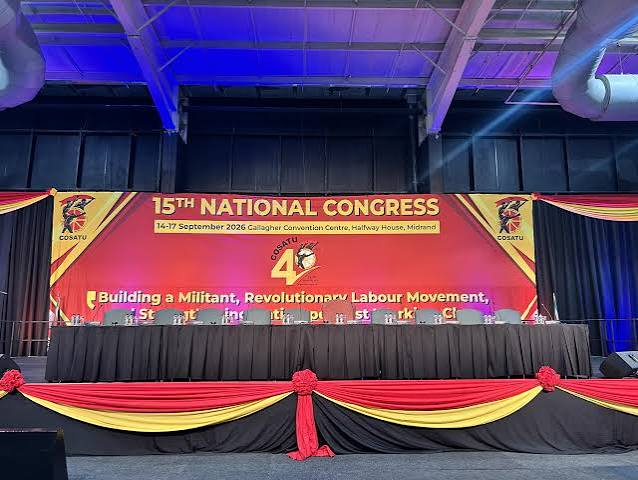
This rejoinder responds to Dr Zamani Saul’s article, Collapse of COSATU’s 15th National Congress is Due to Union Leadership’s Political Elitism and the ANC/SACP Gridlock, published on 19 September 2026. While Dr Saul’s article correctly identifies the degeneration of sections of trade union leadership into a political elite and links the collapse of COSATU’s 15th National Congress to factional gridlock in the ANC/SACP/COSATU terrain, this rejoinder argues that the diagnosis remains incomplete unless it is located within the wider crisis of South Africa’s developmental constitutional project. The collapse of developmental trade unionism cannot be explained only by union leadership elitism; it must also be understood as the consequence of a developmental state weakened by an adrift liberation movement, now sustaining state power through a liberal-order coalition arrangement. The rejoinder therefore advances a class-centred argument: COSATU’s renewal requires more than moral denunciations of elitism. It requires democratic worker control, a reconfigured developmental-left bloc, worker-directed investment mandates over contribution-based funds, and a renewed commitment to transforming the constitutional promise of dignity, equality and social justice into material working-class power.
Introduction
Dr Zamani Saul’s article performs an important political function: it refuses to sentimentalise trade union leadership and insists that the collapse of COSATU’s 15th National Congress must be read as evidence of political elitism within the labour movement. His critique is sharp because it exposes how sections of union leadership have moved away from the shop floor, become entangled in state power, investment arms and factional battles, and increasingly reproduce the habits of the political establishment they once claimed to challenge. In this respect, the article correctly names an uncomfortable truth: organised labour cannot renew itself while its leadership is socially detached from ordinary workers and materially invested in elite circuits of influence.
However, a rejoinder is necessary because the crisis cannot be reduced to the moral or sociological degeneration of union leaders alone. Dr Saul’s argument identifies a symptom, but the totality lies deeper. COSATU’s present disorientation is inseparable from the fate of the developmental state, the unresolved meaning of the negotiated constitutional order and the ideological drift of the liberation movement after the May 2024 electoral rupture. A federation born out of strategic and developmental unionism cannot remain coherent when the liberation movement to which it is historically tied begins to sustain state power through a coalition arrangement whose dominant grammar is liberal constitutional proceduralism, investor reassurance, fiscal restraint and coalition moderation.
This rejoinder therefore argues that developmental trade unionism can survive only where three projects reinforce one another: a developmental constitutional order that treats rights as instruments of material transformation; a developmental state capable of planning, producing, disciplining capital and expanding public goods; and a labour movement independent enough to impose worker control over both the state and the economic institutions sustained by workers’ deferred wages. Without such alignment, COSATU risks becoming either the militant choir of a fading liberation tradition or the industrial police of a liberal coalition settlement. The task is not simply to condemn union elitism, but to reclaim developmental unionism as a class project grounded in worker control, democratic planning and the radical possibilities of South Africa’s constitutional order.
Developmental Unionism as a Class Project
This rejoinder begins from a harder theoretical proposition: developmental trade unionism is not an administrative preference, a congress slogan or an inheritance from the heroic memory of resistance. It is a class project rooted in the struggle over the organisation of production, the distribution of surplus and the political direction of the state. In Marxist terms, it accepts that the workplace is not only a site of wage bargaining but a terrain of class struggle, where labour confronts capital over the command of surplus value and the social purposes of accumulation. COSATU’s historic meaning was therefore never reducible to collective bargaining. Its deeper significance lay in its attempt to convert worker organisation into a counter-hegemonic force capable of linking the mine, the factory, the township, the rural village and the democratic state into one programme against racial capitalism.
The Constitutional Terrain and the Historic Bloc
This is why developmental trade unionism requires more than militant vocabulary. It requires what Gramsci would call a historic bloc: an organised alignment of class forces, institutions, ideas and state power capable of making transformation appear both necessary and common sense. A developmental constitutional order can play such a role only if rights are treated not as liberal ornaments but as instruments of material redistribution, productive restructuring and social emancipation. The Constitution must be read not as a neutral legal compact above class struggle, but as a terrain on which contending social forces fight over the meaning of dignity, equality, property, redistribution and state power. Without that dialectical understanding, constitutionalism becomes a polite language through which the working class is asked to admire promises that the political economy refuses to deliver.
The Developmental State as Condensed Class Power
But constitutional transformation cannot be sustained by courts, commissions, policy seminars and moral declarations alone. It requires a developmental state with planning intelligence, coercive capacity, fiscal courage and ideological coherence. In Marxist terms, the state is not a neutral referee hovering above society; it is a condensation of class relations and a terrain through which class power is organised, contested and reproduced. A developmental state must therefore do more than administer programmes. It must discipline capital, direct investment, build productive capacity, expand public goods, protect labour and restructure the economy away from the inherited colonial division of wealth, work and territory. Without such a state, the developmental Constitution is stripped of its transformative teeth and reduced to a ceremonial text that manages disappointment while capital continues to command the real levers of social life.
From Liberation Movement to Passive Revolution
Here lies the tragedy of the present moment. The developmental state is being choked not only by administrative weakness, fiscal constraint or bureaucratic decay, but by an adrift liberation movement that has lost the ideological will to construct a working-class hegemonic project. Once a liberation movement ceases to define state power as an instrument of class transformation and begins to treat it as a fragile arithmetic of parliamentary survival, it stops leading a historic bloc and begins managing a passive revolution. In Gramscian terms, the movement no longer organises the subaltern classes into political initiative; it absorbs their energy, moderates their demands, and repackages their anger into safe institutional forms. It curates consent for a social order it once promised to rupture.
The GNU as a Liberal Historic Bloc
The Government of National Unity must therefore be understood as more than a tactical coalition arrangement. It is an ideological re-composition of the post-apartheid order. It signals a dangerous attempt to stabilise state power through a liberal historic bloc whose organising common sense is fiscal restraint, investor confidence, coalition moderation, procedural stability and market reassurance. In this bloc, transformation is permitted only when it is harmless to capital; redistribution is acceptable only when it is fiscally anaesthetised; industrial policy is tolerated only when it does not threaten established monopolies; and worker power is respected only when it remains disciplined inside bargaining chambers, summit resolutions and carefully choreographed declarations. The GNU is thus not simply a government format. It is a political pedagogy teaching the liberation movement to think in the vocabulary of its former adversaries.
The Revolving Door of Incumbency and Labour Elites
The most corrosive expression of this liberal historic bloc is the revolving door between governing-party incumbency, trade union leadership, state office and the commanding heights of capitalist accumulation. This is not merely a moral lapse by ambitious individuals; it is a material mechanism of class formation. In Marxist terms, the revolving door converts sections of the labour bureaucracy into a petty-bourgeois managerial fraction whose social reproduction increasingly depends less on workers’ collective power than on proximity to the state, access to public resources, investment vehicles, procurement circuits, pension capital and corporate boards. The union leader rises from the shop floor into the federation, from the federation into Alliance politics, from Alliance politics into Parliament, Cabinet, state-owned enterprises, regulatory agencies or union investment arms, and then returns to labour politics as a custodian of moderation. What appears as career mobility is, in class terms, a process of incorporation: the organic intellectual of labour is transformed into the functionary of capitalist stabilisation.
This circulation disciplines consciousness before it disciplines action. The cadre who once interpreted the strike as a weapon of class struggle now learns to view it as a risk to fiscal credibility, investor sentiment, electoral stability and portfolio value. Wage militancy becomes a budgetary problem. Worker anger becomes a reputational liability. Mass mobilisation becomes a threat to coalition management. The language of class struggle is retained for congress platforms, but the real grammar of decision-making becomes accumulation, governability and risk management. In this way, the labour bureaucracy is not simply bought off; it is reorganised into the political economy of consent. Its function is to translate working-class anger into manageable institutional signals and to ensure that the extraction of surplus continues without the rupture that exploited workers might otherwise impose.
Legalised Liberation and the Compliant State Architecture
This revolving door is reinforced by a compliant state architecture that performs a more sinister ideological function: it legalises liberation while neutralising its revolutionary content. The Constitution contains the grammar of emancipation: dignity, equality, labour rights, social security, housing, education and accountable public power. Yet under a state committed to managing capitalism rather than transforming its foundations, these promises are converted into legality without rupture. Liberation is juridified, sanitised and caged. It is recognised by law, praised in speeches, litigated in courts and audited in annual reports, but it is forced to pass through fiscal ceilings, procurement rules, budgetary caution, investor confidence, debt discipline and macro-economic orthodoxy. The oppressed are told that their emancipation exists because it is justiciable, even as the material conditions of their oppression are reproduced with constitutional politeness.
This is the cruel genius of constitutional legality under a compliant capitalist state: it does not need to abolish liberation promises; it only needs to administer them to death. It turns radical demands into procedure, transformation into compliance, equality into policy language, redistribution into litigation strategy and working-class impatience into a governance nuisance. The law becomes the velvet glove of class power. It offers recognition without redistribution, voice without command, rights without resources and dignity without material emancipation. COSATU’s compass is disoriented precisely because it is asked to defend a constitutional promise whose legal form remains sacred while its material substance is emptied out by the very state architecture its allies now manage. The federation is trapped defending the legality of liberation while the political economy of liberation is quietly buried beneath the rituals of compliant constitutionalism.
COSATU’s Hegemonic Dislocation
This is the context in which COSATU’s compass becomes disoriented. A federation formed to act as the organised will of labour now finds itself tied to a governing arrangement whose ideological centre of gravity pulls away from class struggle and toward liberal equilibrium. COSATU is expected to sound militant while its political home normalises class compromise. It is expected to defend a developmental constitutional order while the state required to give that order material content is disciplined by coalition caution and market sentiment. It is expected to speak the language of worker power while the GNU converts worker anger into a disturbance that must be managed rather than a force that must reorganise society. This is not merely strategic confusion; it is hegemonic dislocation. COSATU no longer knows whether it is the tribune of labour, the left flank of the state, the moral conscience of the Alliance, or the industrial police of a liberal coalition settlement. A federation cannot offer workers direction when the historic bloc to which it is attached has itself lost direction. Developmental trade unionism cannot survive as ritual militancy inside a GNU that converts the liberation movement from a vehicle of rupture into an administrator of class compromise.
State Capitalism and the Question of a Reconfigured Alliance
What, then, is to be done after the rupture of the Alliance, if one refuses the sentimental fantasy that it can simply be reorganised back into its original character? The answer cannot be a romantic return to the old Tripartite Alliance, because that Alliance was itself the conveyor belt through which organised labour was drawn into the state, disciplined by incumbency and absorbed into the management of capitalist stability. Nor can the answer be a pure syndicalist retreat into the workplace, as though the state can be abandoned to capital while workers build islands of militancy at the point of production. The strategic question is whether a new left configuration can be built around a consciously developmental form of state capitalism: not neoliberal capitalism with a liberation anthem, but a state-directed accumulation regime in which the commanding role of public power is used to industrialise, expand productive capacity, discipline private capital and subordinate markets to national developmental priorities.
The Chinese experience is instructive precisely because it cannot be copied crudely. Its significance is that it demonstrates, against liberal orthodoxy, that markets do not have to command the state; the state can command markets. Through planning capacity, public ownership, party discipline, industrial policy, infrastructure mobilisation and strategic control over finance, China has shown that capitalism can be bent toward national developmental purposes rather than left to the anarchy of private accumulation. For a left project in South Africa, this raises a provocative possibility: state capitalism may be a transitional instrument through which a weak, deindustrialised and dependent economy is reorganised, provided the state has the capacity to direct capital, protect strategic sectors, build public enterprises, expand employment and use surplus for social development rather than elite enrichment.
But this proposal must be held together with a sharper Marxist and Gramscian critique. State capitalism is not socialism, and the Chinese model demonstrates this contradiction with brutal clarity. It can defeat liberal market fundamentalism while preserving wage labour as a subordinated social relation and surplus extraction as the organising logic of production. It can build world-class infrastructure while treating workers as disciplined inputs in a national accumulation machine. It can plan production, direct finance and expand industry while denying the working class independent political command over the surplus it produces. In Marxist terms, Chinese-style state capitalism does not abolish exploitation; it changes the form through which exploitation is organised, shifting command from dispersed private capital to a party-state that manages accumulation from above. Capital is disciplined, but labour is also disciplined. Markets are subordinated, but workers are not necessarily emancipated. Development is achieved, but often through the compression of dissent, the containment of independent unionism and the elevation of productivity into a civic duty.
Gramsci helps sharpen the warning. A party-state can construct a developmental common sense in which sacrifice, discipline, growth and national competitiveness appear as patriotic duties. But such hegemony can easily become passive revolution: a transformation from above that modernises the economy without transferring real power to the subaltern classes. Public ownership can become bureaucratic ownership. Planning can become command from above. Industrial policy can become a theology of growth that sacrifices worker autonomy, ecological justice and democratic participation at the altar of national competitiveness. For a South African left project, the warning is decisive: a state that commands capital can still become a state that commands labour. If COSATU embraces state capitalism without insisting on worker control, democratic planning and independent labour power, it will merely exchange liberal subordination for bureaucratic subordination. The real task is to build a democratic developmental state in which public power disciplines capital while organised labour disciplines the state itself.
Safeguards for Democratic Worker Control
Any left embrace of state capitalism must therefore be surrounded by democratic safeguards, otherwise it will reproduce a new ruling stratum in developmental language. First, strategic public enterprises and state-led industrial funds must include elected worker representation with real decision-making power, not decorative consultation; the RSA labour relations legislative regime accommodates worker committees. Second, all union investment arms must be subjected to transparent member control, annual public reporting, recallable trustee mandates and strict prohibitions against leaders using worker capital as a private ladder into elite accumulation. Third, industrial policy must be negotiated through worker-community planning councils at national, sectoral and municipal levels so that accumulation is judged not only by growth rates, but by jobs created, wages improved, skills transferred, communities rebuilt and ecological harm reduced.
Fourth, COSATU must defend its organisational independence from the state, even when the state claims a left developmental mandate. No federation can discipline a developmental state if its leaders are waiting for deployment, board appointments or investment opportunities. Fifth, a reconfigured alliance must institutionalise labour’s right to dissent, strike, expose corruption, and oppose anti-worker policy without being accused of betraying the national project. Sixth, constitutional legality must be tied to material accountability: every social right must be matched by enforceable industrial, fiscal and budgetary commitments capable of moving resources, ownership and productive capacity toward the working class. Without these safeguards, state capitalism will merely produce a red bureaucracy managing black workers for national accumulation. With them, it could become a transitional terrain on which the working class fights to convert state direction into democratic control.
Seventh, worker-contribution-based funds, including pension, provident, medical aid and other deferred-wage institutions, must be recognised as one of the most important sources of investment liquidity in the economy. These funds are not abstract pools of capital; they are accumulated fragments of workers’ present and future livelihoods. Their social power lies precisely in the fact that they finance infrastructure, equities, bonds, property, private equity and state borrowing. Democratic worker control must therefore enter the investment decision framework at the level of mandate-setting, asset-owner governance, ethical screens, developmental allocation targets and accountability over stewardship, without pretending that every shop-floor delegate must become an actuary, portfolio manager or risk modeller. Workers must determine the social direction of their capital; technical professionals must manage execution within democratically approved mandates.
This distinction is decisive. Worker control over contribution-based funds should not usurp the technical capability of fund management companies, actuaries, trustees, auditors and investment analysts; it should subordinate that expertise to transparent class-conscious mandates. The actuarial obligation to protect long-term benefits, assess liabilities and manage risk must remain intact, but it must operate inside a framework that asks harder developmental questions: where is workers’ capital invested, whose jobs does it create or destroy, does it deepen industrial capacity, does it support worker housing, public infrastructure, township and rural economies, renewable energy, local manufacturing and social ownership, or does it merely chase maximum returns while reproducing the same economic structure that exploits contributors? In this way, worker-contribution-based funds become a conduit for disciplined worker control: not by politicising every technical calculation, but by democratising the purposes, boundaries and accountability of investment power.
This is where the idea of a reconfigured alliance becomes unavoidable. The old Alliance cannot be restored because its historical glue has dissolved: the ANC governs through coalition caution, the SACP is trapped between vanguard rhetoric and electoral uncertainty, and COSATU is torn between worker militancy and proximity to the state. A new alliance, if it is to mean anything, cannot be a nostalgia project or a leadership compact signed above workers’ heads. It must be a programmatic bloc built around industrialisation, public ownership in strategic sectors, democratic planning, worker control, municipal productive capacity, food sovereignty, energy security and a clear break with the liberal common sense of fiscal helplessness. Such an alliance would not be organised around who receives deployment, but around what class project the state must serve.
The rupture of the Alliance should therefore not be mourned as the end of history, nor should it be romanticised as an automatic rebirth of working-class politics. It should be treated as a strategic opening through which the left is forced to abandon inherited comfort and confront the harder question of power: how to build a state that can command capital without becoming capital’s administrator; how to use state capitalism without enthroning a new bureaucratic elite; how to hold constitutional legality together with material transformation; and how to ensure that organised labour does not become either the rebel choir of a dying Alliance or the industrial policeman of a liberal GNU. A reconfigured alliance is possible only if it is no longer organised around loyalty to the old architecture, but around a new developmental class project capable of making the state plan, produce, discipline, redistribute and democratise.
Conclusion: Reclaiming the Developmental Constitutional Project
This is why the elitism argument, while descriptively useful, is theoretically insufficient. It names a symptom but not the totality. Yes, union leaders have become detached, bureaucratised, materially comfortable and politically ambitious. Yes, investment arms, state proximity and factional competition have produced a labour elite that often speaks for workers while living outside their social destiny. But to stop there is to mistake the smoke for the fire. The deeper question is not simply why union leaders became elites; it is why developmental unionism lost the state project that once gave its militancy direction. COSATU’s crisis is not merely a crisis of leaders who abandoned the shop floor. It is a crisis of a liberation movement that abandoned the developmental state as the institutional weapon through which the constitutional promise of social justice was supposed to be realised.
The task, therefore, is not to restore the old Alliance as if history can be rewound. The Alliance cannot unring the consequential May 2024 electoral outcome bell and expect a different sound in the upcoming elections, whether it participates as a party or otherwise. That Alliance belonged to a particular conjuncture of national liberation, negotiated transition and constitutional settlement. Its original character cannot be resurrected by declarations, nostalgia or procedural unity. What can be recovered is more important: the developmental impulse chiselled into the 1990–1996 negotiated constitutional order. That order was not born as a thin liberal bargain to protect procedure while leaving the colonial economy intact. It emerged from negotiations instructed by mass struggle, labour militancy, community mobilisation and the unresolved demand that formal democracy must become social and economic transformation. Its social-rights architecture, equality commitments, labour protections, public-administration values and redistributive possibilities were not decorative clauses; they were constitutional footholds for a developmental state project. To read the Constitution only as legality is to surrender it to liberal minimalism. To read it developmentally is to recover it as a terrain for compelling the democratic state to transform property relations, expand social citizenship and make freedom material.
Developmental unionism must return to that unfinished constitutional project, but without returning to the organisational illusions of the old Alliance. For COSATU and its constituent affiliates, this means that renewal cannot be reduced to cleaner congress administration, leadership rotation or moral appeals against elitism. Renewal must become constitutional in content and developmental in method. NEHAWU, NUM, SADTU, SAMWU, POPCRU, SACTWU and other affiliates must translate the social-rights architecture of the Constitution into sectoral programmes of struggle: public servants must fight for a capable developmental state, mineworkers for industrial sovereignty and mineral beneficiation, teachers for equalising the right to education, municipal workers for developmental local government, police and correctional workers for a security state disciplined by constitutionalism, and clothing and textile workers for reindustrialisation and decent work. In this sense, affiliate renewal must reconnect workplace bargaining to the constitutional promise of substantive equality, dignity, social citizenship and redistributed power.
This requires a new renewal compact inside COSATU: every affiliate must ask how its bargaining demands, organising strategy, investment conduct, political education and public-policy interventions advance the developmental constitutional mandate. Wage struggles must be linked to industrial policy; workplace rights to public goods; pension and provident funds to developmental investment mandates; collective bargaining to redistribution; and service-delivery struggles to the constitutional duty to build a capable, ethical and developmental public administration. The federation’s renewal will therefore be measured not by whether it can convene orderly congresses or issue militant declarations, but by whether its affiliates can become constitutional agents of material transformation in their sectors. COSATU must stop defending the Constitution as a distant legal symbol and begin using it as a working-class instrument for restructuring the state, disciplining capital and compelling redistribution.
COSATU and its affiliates will not be renewed by denouncing elitism alone. They will be renewed only if they reclaim developmental unionism as a class project tied to a democratic developmental state and to the radical possibilities of the negotiated Constitution. The future is neither the old Alliance restored, nor a liberal GNU accepted, nor Chinese-style state capitalism copied. The future must be a South African developmental constitutional project rebuilt from below: affiliates rooted again in workplaces and communities, a federation independent enough to discipline the state, worker-controlled funds directed toward developmental investment, bargaining agendas tied to social rights, and a constitutional order radical enough to convert rights into resources, legality into redistribution, equality into transformed ownership, and dignity into material emancipation. Anything less leaves COSATU trapped between museum militancy and elite incorporation; anything less leaves the liberation promise alive in law but dead in the lives of workers.









Leave A Comment