By Stan Itshegetseng
South Africa mistook silence for weakness and noise for leadership. A political narrative repeated for years deserves one final inconvenience: the evidence.
There comes a point in politics when a description is repeated so often that few remember who first proved it—or whether it was ever proved at all.
Cyril Ramaphosa is indecisive. We have heard it for years: he is too slow; he consults too much; he appoints commissions; he waits, calculates and lacks the killer instinct supposedly required of a President.
Perhaps. But there is a problem: the evidence increasingly refuses to cooperate with the accusation. Nor should we replace one political mythology with another merely because the alternative better suits the story we prefer to tell about power.
So let us attempt something increasingly unfashionable: interrogate the record. Not Ramaphosa the personality, the billionaire, the ANC president, or the figure constructed by admirers and opponents, but Ramaphosa the decision-maker. Let the decisions—and their consequences—account for themselves.
PERHAPS WE HAVE BEEN ASKING THE WRONG QUESTION
South Africa has cultivated a peculiar grammar of political strength. We admire movement: the table struck, the microphone punished, the official dismissed before sunset, the dramatic announcement delivered at full volume. Anger is legible to us because it performs itself. Restraint confuses us. Consultation irritates us. Process bores us. Silence, most of all, is interpreted as weakness.
But what if decisiveness is not measured by the speed with which a politician satisfies the emotional temperature of the moment? What if the better test is whether a decision survives after the cameras leave—and whether it builds capacity rather than merely performing command?
That question takes us back to 2017. Ramaphosa campaigned for the ANC presidency around renewal, restoration of institutional integrity, confronting corruption and rebuilding public confidence after State Capture. When he subsequently became President of the Republic, he inherited institutions that could not simply be repaired through presidential speeches.
SARS required reconstruction. The NPA required credibility. State intelligence required examination. Law enforcement capacity against sophisticated corruption required rebuilding. State Capture required investigation. The response was not one spectacular purge.
What followed was institutional sequencing: the Nugent Commission and the reconstruction of SARS; new leadership at the NPA; the review of the State Security Agency; the Zondo Commission; the Investigating Directorate; the Special Tribunal; and, later, a permanent Investigating Directorate Against Corruption.
One may legitimately argue that some of this reconstruction moved too slowly. One may point to prosecutions that failed. One may question appointments. One may ask why particular individuals remained in office as long as they did.
Those criticisms belong in any serious assessment of Ramaphosa. But they cannot erase the architecture that was being constructed. And architecture is important because anybody can break a window quickly. Rebuilding the house takes longer.
THEN THE WORLD STOPPED
COVID was not a seminar in political theory. People were dying. Economies were closing. Governments were improvising. Vaccines eventually arrived, but the distribution of those vaccines exposed the brutal hierarchy of the international system. Africa could wait. The wealthy world could buy. South Africa refused to accept that arrangement quietly.
Ramaphosa became an important voice in the international campaign for vaccine equity and greater African manufacturing capacity. South Africa became home to the WHO backed mRNA technology transfer hub. The larger strategic principle mattered.
Africa could not remain permanently dependent on the goodwill of somebody else’s pharmaceutical industry whenever the next pandemic arrived. That was not a decision designed for tomorrow morning’s headline. It was a decision about capability.
This brings us to Lee Kuan Yew, the Singaporean leader who framed governing as calculation beyond the next election. South Africa is not Singapore, and Ramaphosa is not Lee. Yet the distinction between calculation and paralysis matters. What looks slow at ten o’clock in the morning may look very different ten years later.
AND THEN SOUTH AFRICA WALKED INTO THE HAGUE
Here the inadequacy of the word “indecisive” becomes more serious. For decades, governments expressed solidarity with Palestine through statements, resolutions, marches, flags and humanitarian assistance. All of this mattered—but it remained largely within the register of declaration.
But on 29 December 2023, South Africa crossed a different line. It instituted proceedings against Israel before the International Court of Justice under the Genocide Convention. South Africa put its own name on the application. That distinction is enormous. The Republic was no longer simply saying what it believed. It was asking the world’s highest court to subject those allegations to international law.
There was no guarantee that the Court would agree, or that South Africa would satisfy the threshold for provisional measures. The diplomatic consequences were obvious; Israel had powerful allies, including the United States. South Africa proceeded nonetheless. Naledi Pandor stood firm, but she did not conduct a private foreign policy from an independent republic called DIRCO. She served in Ramaphosa’s Cabinet. The decision belonged to a government.
And then came 26 January 2024. That is the date I believe history will return to. The International Court of Justice did not determine that Israel had committed genocide. We should be absolutely clear about that. But neither did it dismiss South Africa as some reckless African government performing ideological theatre. The Court found that at least some of the rights South Africa sought to protect were plausible.
It found a real and imminent risk of irreparable prejudice to those rights. The conditions for provisional measures had been satisfied. By fifteen votes to two, the Court ordered Israel to take all measures within its power to prevent acts falling within Article II of the Genocide Convention. Those provisional measures were binding.
South Africa had done something fundamentally different from issuing another statement. It had converted principle into litigation. Litigation into judicial scrutiny. Judicial scrutiny into binding international legal obligations. David did not defeat Goliath by becoming Goliath. He found the instrument available to him. For South Africa, that instrument was international law. And when Pandor subsequently left government, Ronald Lamola continued defending the policy. That continuity matters.
The continuity of the case under Ronald Lamola confirms that this was not Pandor’s personal foreign policy, but state policy under the Ramaphosa administration. South Africa returned to the Court as conditions changed; additional measures followed and the litigation continued. Whatever one’s position on Israel, Palestine or the legal arguments, one proposition is extraordinarily difficult to sustain: this was not indecision. It was among democratic South Africa’s most consequential foreign-policy choices, shifting the Palestinian question from the veto-bound arena of diplomacy into a forum of legal adjudication.
THEN CAME MKHWANAZI
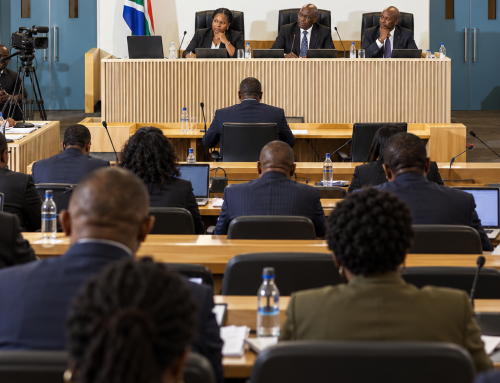
On 6 July 2025, Lieutenant General Nhlanhla Mkhwanazi detonated allegations that went directly to the integrity of the South African criminal justice system. His allegations raised questions concerning political interference, organised crime, law enforcement, intelligence and the possible penetration of institutions responsible for protecting the Republic.
The country erupted as confidence in policing imploded. Everyone wanted an answer immediately: arrests, suspensions, dismissals, or a presidential verdict on who was telling the truth before the evidence had been tested. Seven days later, Ramaphosa established the Madlanga Commission. Seven days.
This is where language matters. You may dislike commissions. You may believe South Africa has too many of them. You may eventually conclude that Madlanga achieved too little. But a President responding to extraordinary allegations concerning the criminal justice system by establishing an independent judicial mechanism within seven days is not doing nothing. He has made a decision about how the truth will be established. That is different.
AND THEN NKABINDE ANSWERED
The Andrew Chauke matter gives us an even more interesting test. Chauke was suspended. An independent inquiry was established under the National Prosecuting Authority Act. It was chaired by retired Constitutional Court Justice Bess Nkabinde. And then the process produced an answer. Not necessarily the answer everybody expected.
The Panel found no credible evidence that Chauke had taken the alleged prosecutorial decisions in the Cato Manor matter or had acted unlawfully in performing his coordination functions. On 27 August 2026, Ramaphosa authorised publication of the report. The Presidency recorded that Chauke had been exonerated and that there was no basis for finding him unfit to hold office. That was an important constitutional moment.
Because independent processes mean very little if Presidents accept their findings only when those findings confirm what Presidents already believe. The test of institutionalism comes when the institution gives you an inconvenient answer.
THE OVAL OFFICE
Then there was Donald Trump. The cameras were waiting. The theatre was ready. Claims concerning white South Africans, land and alleged persecution were dramatically presented in the Oval Office.
Ramaphosa could have performed outrage, walked out, or attempted to defeat Trump at Trump’s own political game. He did not. Some read that restraint as weakness. Yet diplomacy is not heavyweight boxing. A President does not travel thousands of kilometres to win a viral clip; he travels to protect national interests. Sometimes the most consequential decision in a hostile room is deciding which provocation does not deserve your reaction.
This is where the Buffalo metaphor becomes useful. You do not charge every red cloth somebody waves in front of you. You first establish who is holding it; and why.
THE G20 TEST
The same temperament became visible when South Africa chaired the G20. The United States stayed away from the Johannesburg Leaders’ Summit. South Africa proceeded. The summit happened. A declaration was produced. Africa hosted the G20 Leaders’ Summit for the first time. South Africa did not surrender its multilateral agenda because Washington disapproved. Nor did Ramaphosa respond by turning foreign policy into an insult competition.
That combination deserves closer attention. Firmness without hysteria. Engagement without surrender. Sovereignty without theatre. Perhaps that is a form of decisiveness we have become intellectually unequipped to recognise.
HAYI KHONA
At some point, mara, the facts must be allowed to interrupt the story. The question is disarmingly simple: which indecision?
The President who entered office talking about institutional renewal and then reconstructed key institutions? The President whose administration pursued vaccine equity while Africa stood at the back of the queue? The President whose Cabinet authorised South Africa to take Israel before the International Court of Justice under the Genocide Convention? The President whose government stood behind Naledi Pandor and continued that policy under Ronald Lamola?
The President who answered Mkhwanazi’s explosive allegations by establishing the Madlanga Commission within seven days? Who initiated the Nkabinde process and then accepted its exoneration of Chauke? Who absorbed extraordinary provocation in Washington without abandoning the purpose of the diplomatic engagement? Who proceeded with South Africa’s G20 programme despite American opposition? Which indecision are we actually describing?
Hayi khona. Perhaps we have been watching the wrong animal. Ekasi, we know the difference between somebody who is afraid to move and somebody who is measuring the distance. That may be what was misunderstood about the Buffalo. While everyone shouted, “Move, President, move,” perhaps he was calculating where to place the horns.
BUT THIS CANNOT BECOME A PRAISE SONG
And here is where intellectual honesty requires something from those of us making this argument.
Ramaphosa must still answer for his failures. Unemployment remains devastating. Municipal government remains deeply troubled. Infrastructure failures continue to humiliate the democratic state. Crime terrorises communities. Some appointments have taken far too long.
There have been moments when consultation appeared excessive and political management uncertain. State Capture accountability has moved much more slowly than millions of South Africans expected.
These are not footnotes. They belong in the assessment. But acknowledging failure does not require us to accept an inaccurate description of the man responsible for addressing it.
A President can make bad decisions and still be decisive. A President can make good decisions too slowly. A President can deliberate appropriately in one crisis and procrastinate unnecessarily in another. Politics becomes childish when one adjective is expected to explain an entire presidency.
THE REAL FAILURE MAY HAVE BEEN OURS
Perhaps the deeper problem lies not only with Ramaphosa, but with how we consume politics. Someone coins a description. A politician repeats it. A headline amplifies it. A television panel circulates it. Social media reduces it to six words. WhatsApp carries it into intimate communities. Eventually we repeat it ourselves, until repetition masquerades as evidence. That is dangerous.
Not because Ramaphosa deserves protection from criticism. He does not. No President does. It is dangerous because democracy requires citizens capable of interrogating power and interrogating the narratives about power. If somebody tells us Cyril Ramaphosa is brilliant, we want evidence. If somebody tells us he is useless, we want evidence. And if somebody tells us Cyril Ramaphosa is indecisive, then give us the decision. Give us the date. Give us the constitutional power available to him. Tell us what information he possessed.
Tell us what alternatives existed. Tell us how long he took. Tell us what he eventually decided. Then tell us what happened afterwards. That is analysis. Everything else risks becoming political folklore.
THE VERDICT BELONGS TO HISTORY
This essay does not ask readers to inherit its conclusion. Quite the opposite: challenge it. Return to 2017. Reconstruct the chronology. Read the commission reports, including those that implicate the President. Read the legislation, the judgments and the ICJ order of 26 January 2024. That order imposed binding provisional measures while making clear that it did not prejudge the merits of South Africa’s case.
Study what happened after each supposedly indecisive moment. Then make up your own mind. Because perhaps the greatest analytical mistake of the Ramaphosa years has been judging presidential leadership by the visibility of movement rather than the durability of consequence. Maybe silence was sometimes hesitation. Maybe sometimes it was uncertainty. Maybe sometimes it was political caution.
But the evidence increasingly suggests that sometimes silence was something else entirely. Calculation. Sequencing. Restraint. Institution building. The deliberate refusal to allow the emotional temperature of a crisis to determine the constitutional temperature of the response.
There is a profound difference between a President who does not know what to do and one who has decided that an institution must determine what happens next. History will decide which description ultimately fits Cyril Ramaphosa. But one thing should no longer be acceptable: we cannot simply inherit the verdict. The Buffalo has been charged with indecision.
The evidence has now entered the courtroom. Let the case be argued.


THE BATTLE OF ESTABLISHMENTS: UNPACKING THE MOTSEPE SUCCESSION DEBATE
The article by Dr Lucky Mathebula raises an important question about South Africa’s democratic future: who determines political leadership—the democratic structures and citizens, or powerful networks operating behind the scenes?
However, the article should be read critically rather than as established fact. Some of its strongest claims—particularly about “hidden networks”, a “deep state”, criminal networks and an alleged programme to capture the ANC—are analytical assertions and allegations, not facts established by the article itself.
1. What is the real issue?
The Motsepe debate should not simply be reduced to:
> “Is Patrice Motsepe going to become ANC President?”
The deeper question is:
> What kind of ANC leadership does South Africa need, and what programme must that leadership implement?
The article argues that Motsepe is being presented as an increasingly inevitable leadership option and warns against allowing wealth, media narratives, elite networks or personal popularity to determine political choices before ANC structures have spoken.
This is an important democratic concern.
At the same time, recent reporting shows that Motsepe’s possible candidacy remains speculative. He has repeatedly distanced himself from suggestions that he wants the ANC presidency, while the PM27 campaign has continued promoting him as a possible successor to President Cyril Ramaphosa.
Therefore, we should distinguish between:
Fact: Motsepe’s name is increasingly prominent in succession discussions.
Claim: A powerful establishment is deliberately manufacturing him as the inevitable next president.
Political question: If he becomes a candidate, what programme would he bring to the ANC and the country?
Those three things must not be confused.
2. From personality politics to programme politics
This is probably the strongest lesson from the article.
South African politics has repeatedly become excessively personality-driven. Leaders become the political programme instead of being judged against a programme.
The article itself argues for moving “from personality to programme”, asking what Motsepe actually stands for in policy terms.
This principle should apply equally to every potential ANC leadership candidate.
The question should not be:
Is Motsepe rich?
Is Mashatile experienced?
Is Mbalula politically strong?
Is another candidate popular?
Who has the strongest faction?
The questions should be:
1. What is the economic programme?
2. How will unemployment be reduced?
3. How will local government be fixed?
4. How will corruption and state capture be defeated?
5. How will the criminal justice system be protected?
6. How will the ANC rebuild its branches?
7. How will public confidence be restored?
8. How will inequality and poverty be addressed?
9. What is the programme for industrialisation and township economies?
10. How will South Africa strengthen its position in Africa and the Global South?
That is the level at which succession politics should be debated.
3. The danger of an “inevitability narrative”
The article’s most important warning is about manufactured political inevitability.
If the public repeatedly hears:
> “This person is the only credible candidate.”
eventually the statement can begin to sound like fact.
That is how political narratives can shape political choices before formal democratic processes take place.
But there is an important counterpoint: public popularity does not automatically translate into ANC presidential viability.
Recent analysis has noted that Motsepe’s public profile and polling support do not automatically give him the branch nominations, provincial support and organisational machinery required to win an ANC elective conference.
Therefore:
Popularity ≠ nomination.
Money ≠ political mandate.
Media visibility ≠ organisational support.
Business success ≠ competence in running the state.
And equally:
Political experience ≠ guaranteed leadership quality.
Every candidate must ultimately be tested against the programme and the constitutional and organisational processes.
4. The ANC must protect itself from both external and internal capture
The article makes a serious argument that powerful economic or criminal networks can seek influence over political institutions. It links this concern to evidence emerging from the Madlanga Commission.
This issue should not be dismissed.
South Africa has already experienced the devastating consequences of state capture. The lesson should therefore be:
> No individual, faction, business interest, criminal network or external establishment must be allowed to capture the democratic state.
But the response must be evidence-based.
We should avoid automatically labelling every political disagreement as “state capture” or every successful businessperson as part of a conspiracy.
The standard must be evidence, transparency and accountability.
5. The ANC’s biggest protection is organisational democracy
The strongest defence against hidden influence is not speculation about hidden networks.
It is a strong, politically educated and organisationally disciplined membership.
If branches are active, members understand ANC policy, delegates are properly mandated, nominations are transparent and conference processes are respected, it becomes much harder for external interests to manufacture leadership outcomes.
The ANC’s own current programme places emphasis on decisive action to fix local government and transform the economy.
Therefore, succession politics must not distract the organisation from the immediate political task.
2026 is not merely a preparation year for 2027. It is a test of whether the ANC can reconnect with communities and demonstrate governing capacity.
6. What should ANC Political Education do now?
This is where the discussion becomes particularly relevant to Political Education and Cadre Development.
I would recommend that the debate be turned into a political-education programme titled:
“FROM PERSONALITIES TO PROGRAMMES: UNDERSTANDING ANC SUCCESSION, DEMOCRATIC POWER AND THE NATIONAL INTEREST”
The session should examine:
A. Understanding succession
What is ANC leadership succession?
How does the ANC’s elective process work?
What is the role of branches?
What is the role of provinces?
What is the role of delegates?
Why must constitutional and organisational procedures be respected?
B. Understanding establishments
What is an economic establishment?
What is a political establishment?
What constitutes undue influence?
What is state capture?
How does legitimate lobbying differ from corruption or improper influence?
C. Understanding candidates
Every potential leader should be assessed against the same matrix:
Criterion Question
Political integrity Can the person be trusted with public power?
Organisational experience Can they build and lead the organisation?
State capacity Can they manage government effectively?
Economic programme What is their economic transformation agenda?
Social programme How will poverty and inequality be tackled?
Anti-corruption What concrete measures will they implement?
ANC policy Are they committed to Conference resolutions?
Constitutionalism Will they respect institutions and the rule of law?
Mass mobilisation Can they reconnect the ANC with society?
National interest Whose interests ultimately guide their decisions?
This prevents personality worship and factional thinking.
7. The immediate strategic priority: rebuild the organisation
The succession debate must not become an excuse for abandoning organisational work.
The ANC should concentrate on:
Branches → Communities → Local government → Economy → Service delivery → Voter confidence → Organisational renewal.
The current ANC programme explicitly identifies fixing local government and transforming the economy as central priorities.
For Political Education, this means cadres must be equipped to answer ordinary people’s questions:
> “What difference does the ANC make in my community?”
That answer cannot simply be historical.
It must be demonstrated through present-day delivery, organisation, accountability and credible solutions.
8. A warning against factional mobilisation
There is another danger.
The Motsepe debate could easily become:
Motsepe vs Mashatile
or
one faction vs another faction.
That would reproduce precisely the problem that political education should overcome.
The better approach is:
> Programme before personality. Organisation before faction. National interest before private interest. Democratic process before political inevitability.
If Motsepe eventually becomes a candidate, assess him.
If Mashatile becomes a candidate, assess him.
If Mbalula becomes a candidate, assess him.
If a credible woman candidate emerges, assess her.
Apply the same political and ethical standard to everybody.
9. The strategic conclusion
The most useful contribution of the article is not that it proves the existence of a particular “establishment”.
It is that it forces us to ask a more fundamental democratic question:
Who controls the direction of the South African state?
The answer must be:
The Constitution, democratic institutions, the electorate and accountable political leadership—not hidden networks, private wealth, criminal interests or factional establishments.
And within the ANC:
> The organisation must choose its leaders through legitimate democratic processes, while leaders must be judged by their political programme, organisational record, integrity and ability to advance the national interest.
The succession debate therefore provides an excellent opportunity for political education rather than political speculation.
WAY FORWARD
1. Do not prematurely endorse or reject Motsepe.
Study the facts and his actual programme if he formally enters the contest.
2. Reject personality politics.
Make every leadership contender explain their programme.
3. Strengthen branch democracy.
Educated and active branches are the best defence against manipulation.
4. Demand transparency.
Political funding, lobbying, business interests and relationships with government must be subject to appropriate scrutiny.
5. Defend state institutions.
No political, economic or criminal network should own or capture the state.
6. Prioritise organisational renewal.
The ANC’s immediate task is to rebuild trust through visible work in communities and competent governance.
7. Prepare cadres for informed succession discussions.
Political education must replace rumours, WhatsApp narratives and factional propaganda with evidence, policy and organisational principles.
8. Keep 2027 in perspective.
Leadership succession matters, but the quality of the programme and the capacity to implement it matter even more.
Political Education Message
> The ANC must not ask merely, “Who should lead?” It must first ask, “What must be done, what programme will achieve it, and who has the capacity, integrity and organisational commitment to implement that programme?”
That is how we move from personalities to programmes, from factionalism to organisation, and from political speculation to democratic accountability.