
Celebrated habits become consequential values of society; youth is forever in a quest to be adults, albeit reluctantly
Africans have always known that a serious lesson travels better when it is disguised as a story. A proverb enters the room smiling, sits down quietly and, before anyone notices, has disciplined the entire household. This is why metaphors and parables remain among the finest instruments of African education: they allow society to laugh at itself without immediately calling a family meeting.
From lived experience, communities develop values, norms and habits. At first, these are merely things people do. Then they become things people expect. Eventually, they become things people defend with great confidence and very little evidence. A living pattern, repeated often enough, can become a moral code—or a national problem with catering.
The Table as a School of Conduct
One useful place to study conduct is the eating environment. Leadership theories may fill libraries, but the dinner table offers quicker evidence. Observe who waits, who shares, who reaches across everybody, who quietly enlarges his portion and who suddenly remembers communalism only after the meat is finished. The table does not issue certificates, yet it graduates citizens daily.
Traditionally, food was shared from common containers. The exercise required rhythm, restraint and the basic understanding that the hand moving fastest was not necessarily the hand most deserving. Children learned that the person beside them also had a stomach, a fact that later became the foundation of fairness, neighbourliness and the revolutionary concept of leaving something for others.
Hence the wisdom in the saying, ‘vana va munhu va tsemelana nhloko ya njiya’: children of one household will share even the head of a locust. The locust, one imagines, was never consulted. Still, the lesson is clear: the size of the resource does not cancel the duty to share. Family conduct thus travels outward, to the village, the community, the workplace and, if it survives the journey, the nation.
Every shared meal develops a pecking order and an unwritten constitution. Rules govern waiting, hygiene, waste, and greed. The elder’s glance may function as the ethics committee; the aunt serving meat is the treasury; and the child caught returning for a third piece becomes the subject of immediate parliamentary oversight. Table manners are therefore not decorative. They regulate appetite so that appetite does not regulate society.
From Communal Meal to LESENKE
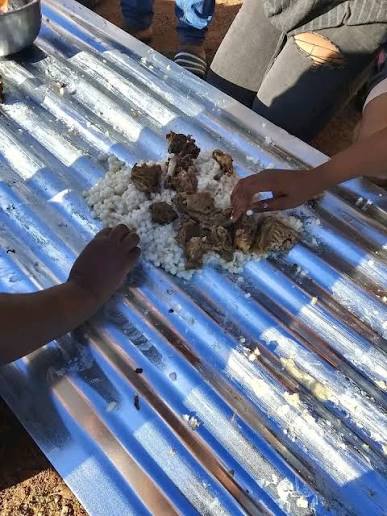
Industrialisation disrupted this intimate classroom. Mines and male hostels reorganised time, space and eating. Meals had to move at the speed of production. Serenity was dismissed for poor performance, and efficiency arrived carrying steel tables. In that hard environment, the corrugated iron sheet known as LESENKE became a practical mass-serving device.
Over time, LESENKE escaped its historical circumstances and acquired a social life of its own. It now appears at gatherings, especially funerals, where the corrugated sheet takes office, and the men assemble around it. Once the food lands, titles disappear, elbows discover ambition and respected gentlemen briefly become contestants in an event for which no medal has ever been awarded.
The Politics of Picking, Chewing and Returning
In its advanced form, LESENKE quietly rearranges the manners of the table. The contest is no longer only about who reaches first, but also about who chews and swallows fastest, thereby returning to the sheet for additional picking while slower citizens are still consulting their first mouthful. Digestion becomes strategy; speed becomes advantage; and the quickest jaw begins to behave as though it has received a second-term mandate.
LESENKE also institutionalises a delicate politics of turn-taking: it is now my turn to eat, and once you have had your share, you must kindly open a gap. As the unspoken ‘let me pick while you pick’ tussles harden into routine, they begin to define behaviour beyond the corrugated sheet. They enter other spaces of human coexistence homes, workplaces, institutions and public life where the prevailing mores ought to demand restraint, fairness and regard for others, rather than the competitive instincts that dominate the LESENKE context.
To an uninitiated observer, LESENKE may look like food deposited on corrugated iron and negotiations collapsed. But the humour lies in the mirror it holds up to us. Remove restraint, and the meal becomes a race; remove accountability and public life does the same. Human beings remain civilised not merely because they can eat, but because they can decide how to eat with others.
When LESENKE Leaves the Table
This is where LESENKE becomes more than catering. In the theatre of corruption, the public budget is sometimes treated as if someone has shouted, ‘Gentlemen, the food is ready!’ Procurement rules become optional tablecloths, tenders become serving spoons, and those closest to the sheet persuade themselves that proximity is a constitutional entitlement. The governing principle is simple: eat now, explain later, and preferably appoint a commission after dessert.
The warning is not against LESENKE as an adopted eating practice that is almost assuming cultural significance, notwithstanding its dehumanising origins. It is against LESENKE conduct that escapes the meal and colonises our institutions, relationships, and daily routines. Habits shape norms; norms protect values; values organise living patterns. If grabbing becomes normal at the table, hoarding may soon look clever at work, entitlement may masquerade as leadership, and waste may pass for success.
Who Finished the Values?
Ultimately, LESENKE reminds us that social values are not grand declarations framed on walls; they are habits rehearsed in ordinary encounters. A society committed to Ubuntu, fairness, dignity, restraint and mutual care must practise those values wherever people share space and resources, from the family table to the workplace, the municipality and the state.
When citizens learn to wait their turn, take only what is fair, leave enough for others and recognise the hands that made the meal possible, they sustain norms of reciprocity and patterns of living founded on trust. But when grabbing, speed, and entitlement become admired conduct, the social fabric begins to resemble a crowded LESENKE: everyone is eating, nobody is sharing, and the nation is left wondering who finished the values.










I enjoyed the story of Lesenke in relation to tenders. Keep on writing my classmate.
Profound, serious food for thought and self introspection