
The relationship between
the dominant political force in the GNU, the ANC, and civil society, including
its alliance partner, the SACP, is at an all-time low. This disconnect
underscores the urgent need for better communication and understanding. Without
fail, the ANC is manoeuvring itself into a corner. It might not be easy to
rescue it. The belief that it is the perpetual context of the country’s
politics to a level where its NEC approves itself, despite a 40% and declining
voter support, and that it is the custodian of the National Dialogue, is a
clear sign that it is distancing itself from society.
If
at all, there was one central issue South Africans would want to talk about, it
is the nightmare this country has been unable to wake up from in the last three
administrations. By its admission, the ANC has not refuted that South Africa
went through nine wasted years under one of its past presidents. Some of its current
leaders are quoted as saying that. Its President, Cyril Ramaphosa, declared
that in the dock of corruption, the ANC, while not alone, is accused number one.
Yet, it expects society to trust it with the delicate process of national
reimagination, like the National Dialogue.
The
prospect of losing political power entirely, becoming vulnerable to coalition
arrangements, and forfeiting a position within the country’s Establishment
network can suppress common sense and pragmatism. The reactions, antics, and
attempts to wrest the hegemonic space created by the National Dialogue process
reveal how those who advanced with the National Dialogue away from its original
conceptualisation and format might have lost the ability to understand the
national balance of forces.
For
the past thirty years, the then-governing party, the ANC, has been the main
target of all opposition politics aiming to bring it down. This has led to its
being surrounded by a sophisticated opposition complex with geopolitical
interests that intend to dislodge it as the central axis of political thought.
Its failure to recognise that, in governing the state, it acts as the security
guard for its primary business interests without breaching its post-liberation
transformation obligations has been its most significant challenge.
Consequently,
it adopted a posture of always believing there can be no South Africa without
the ANC. This could be one of the myths in RSA politics that needs to be
challenged, and the citizens restored as the proper drivers of democracy. The
ANC’s perception of its role needs to be redefined. If it is true that the ANC
NEC has assumed the role of guardian of the National Dialogue, then it can no
longer serve as what it was initially meant to be. President Ramaphosa could have
read his speech in Parliament and had an expanded guest list in the gallery.
The
inconvenient reality is that a clear division is forming between the original
idea creators of the National Dialogue process and a rising group of
individuals and institutions. It should be concerning for the main party in the
GNU coalition that its former Presidents still find it easy to oppose most of
its current thinking efforts.
The
reputation deficit that the majority party in the GNU command should have been
a sufficient restraint to prevent it from falling into the trap of being
accused of manipulating a process intended to create a recovery platform.
Sometimes, an organisation’s character rather than its preferred structural
positioning redeems it. The weight of internal contradictions within an
organisation should not obscure its ability to think clearly and succeed for posterity’s
sake.
Undeniably,
the GNU majority party has adopted a specific posture towards its coalition
partner, the DA, and the Legacy Foundations. These Foundations, representing
the legacies of past leaders and presidents, command significant social and
political capital. The opposition of these foundations tends to overstate the
perceived threat they pose. Fear of further losing an otherwise declining
hegemony, which naturally leads those who believe the national dialogue can
only be best managed by them to dismiss other approaches, prevents the majority
party from recognising the opportunity to harness the strengths these
foundations offer for the long-term viability of the democratic and
constitutional order. Reputationally, these foundations can aid in restoring
societal trust in democracy.
The
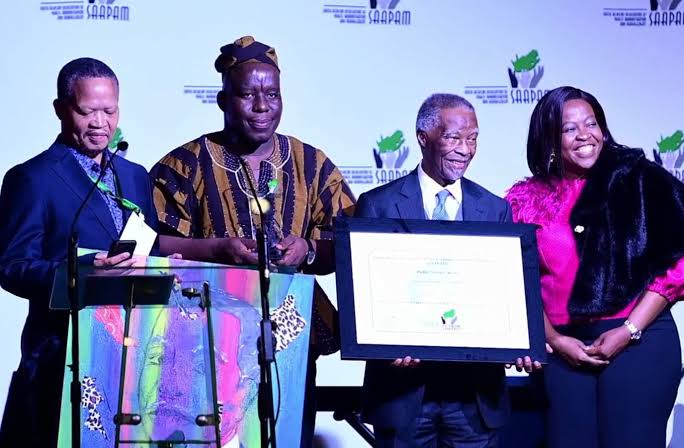
Thabo Mbeki and others factor
The
harsh reality is that the evolving democratic order has elevated several
individuals and selected institutions representing the legacies of past leaders
and presidents to be more than mere puppets of interests. These individuals
include some current holders of political positions. It is unthinkable to
expect that a person who has been the secretary general of the oldest
liberation movement for two terms and subsequently became its national
chairperson would have his voice and concerns about national matters dismissed
as a non-event.
Legacy
foundations and persons such as Thabo Mbeki, Kgalema Motlanthe, and others
command significant social and political capital that will always affect
current politics. They are components of established interests, which you
ignore at your peril. This explains why elites, especially political ones, because
they have a value consensus more than you would find in mass publics, when they
exit their active vocations, their influence assumes a character that embodies deeper
and organised or previously articulated interests.
Believing
that legacies can be divorced from the context that created them is at best
fallacious. The idea of people in politics has always involved recognising
that, once they elect representatives, vested interests will often take over,
leading to decisions made for and about them. Individuals and institutions
wielding cognitive, social, and political capital usually mediate the tyranny
of representative democracy. Introducing eminent persons in the National
Dialogue served as a mechanism to challenge various organised interests without
needing their formal recognition as indispensable.
South
Africa’s concentrated social and political capital role is played by the legacy
foundations and individuals who command influence. Mores, norms, and standards
are difficult to create or establish. However, it is easy when humans practice
over time, as embodied in those we see as models of an era, past or present, and
are curated in institutions, individuals, or literature that become the source
to create or establish them. Legacy institutions, and individuals as
institutions, defined by their unparalleled standing in society, are supposed
to be uniquely capable of channelling societal discontent into positive
energy.
This
influence is so strong that even rehabilitated villains become credible voices
in what is unacceptable in what defines their history. How incumbents relate to
content from past legacies and legends defines how their legacy beyond their
terms will be treated.
Suppose it is true that
former President Jacob Zuma or his legacy foundation was not invited to the
National Dialogue. In that case, the basis of an inclusive process is grossly compromised.
In addition to being a former State President and commanding significant social
and political capital in the country and beyond its borders, he leads the
third-largest party in the country and the largest in the most populous
province. He cannot be airbrushed or watermarked in any process that is
genuinely about the imagination of South Africa.
Similarly, race-based,
culturally preferred, or ethnonationalist-driven civil society movements that
hold significant influence in South Africa cannot be dismissed or altered to
erase their existence. The second sentence, following ‘we the people’, of the
1996 Constitution requires South Africans to ‘recognise the injustices of the
past’. This clear call anchors the inclusivity expected in any process addressing
these injustices. Any discussion about South Africa is incomplete if ‘those who
live in it, united in their diversity, are not part of it’.
Suppose
the National Dialogue is meant to be the oxygen of our social or other change.
In that case, it cannot afford to exclude anyone, regardless of how villainous
society has relegated or defined them. No nation should attempt to move in a
new direction without an inclusive dialogue among its people. Open discussion
or dialogue can uncover hidden barriers hindering societal progress.
This
explains why significant societal changes, including history-defining
revolutions, are viewed through the lens of those who led and laid
philosophical foundations. To suggest or claim that events like the National
Dialogue are a dialogue of equals is to deny the reality of social
stratification and hierarchy. Just as South Africa should refuse any attempt
not to grant incumbents their place in history, it should also reject attempts not
to acknowledge the influence and co-creation rights of those who led
previously.
We
might disagree with what past leaders say or the legacy institutions that
curate their continued influence on posterity, but that does not allow us to
disapprove of their standing in society. They are lampposts of what we have
been and should not have been. Let us engage with the content of what
they say or write. The general need for freedom from the influence of these
individuals or institutions over South African politics should be managed so as
not to be a cult facilitated by a strange breed of leadership in society. If
you cannot choose to be led where you cannot lead, you cannot expect others to
allow you to lead them.




Leave A Comment