
“As long as many of our people still live in utter poverty, as long as children still live under plastic covers, as long as many of our people are still without jobs, no South African should rest and wallow in the joy of freedom.” Nelson Mandela, 26 June 1996.
Whether a governing party may claim credit for public policy achievements goes to the heart of democratic accountability. In South Africa, this question is sharpened by the ANC’s dual identity as both a liberation movement with a long history of policy authorship and a governing party entrusted with the machinery of the democratic state. The issue is not whether the ANC may speak about what has been delivered under its leadership; it is how such claims should be made, what evidence must support them, and where the line must be drawn between legitimate political stewardship and the improper appropriation of public institutions. This article argues that a party may claim credit where there is a clear connection between its programme, its mandate, and the outcomes achieved, but such claims must always remain truthful, humble, and open to public judgement.
1. The Controversy: Claiming Delivery Without Owning the State
The controversy arose from remarks attributed to ANC National Chairperson and Minister of Mineral and Petroleum Resources, Gwede Mantashe, during an election campaign, in which he is reported to have pointed to RDP houses, social grants, no-fee schooling, NSFAS support for higher education and access to public healthcare as achievements delivered under ANC leadership. The objection is that these are not party assets. They are funded from public revenue, administered through democratic state institutions and enjoyed by citizens as rights or public benefits. If such claims are made carelessly, they may sound as though the ANC is saying that the state belongs to it, that beneficiaries owe the party gratitude, or that public entitlements depend on political loyalty. That is why the issue becomes controversial: it sits at the sensitive boundary between legitimate democratic accounting and the unconstitutional conflation of party, government and state.
But the controversy has another side. A governing party is not a mere spectator to state action. It contests elections on a programme, asks voters for authority, uses that mandate to shape legislation and budgets, appoints political executives to drive implementation, and returns to the electorate to account for its record. It would therefore be democratically incoherent to punish a party for unemployment, corruption, service-delivery failure or policy reversal, while denying it the right to point to houses built, grants expanded, schools opened, students funded or clinics constructed under its leadership. The dispute is therefore not whether the ANC may claim credit; it is whether the claim is framed as political stewardship of public policy rather than ownership of public resources.
However, it would be equally wrong to insist that a governing party must remain silent about the policy victories achieved under its mandate. In a democracy, parties contest elections on programmes, receive authority from voters, convert those programmes into laws and budgets, and must later account for what they delivered. The correct position is therefore more nuanced: the ANC may claim political credit for victories that flow from its programme, mandate and leadership in government, provided it does so as a steward of public policy, not as the owner of the state.
2. Why Policy Credit Is Democratically Legitimate
There is nothing inherently wrong with a political party claiming the outcomes of policies that it conceived, campaigned for, translated into legislation and implemented while in government. Democratic elections are contests not only between personalities, but also between competing programmes of action, different ideological orientations and rival accounts of what the state should prioritise. Voters are asked to choose between these programmes, and when a party receives a mandate, it is expected to use public authority to pursue the commitments it placed before society. For that reason, voters have a legitimate interest in knowing whether a governing party has fulfilled the promises contained in its manifestos, conference resolutions and policy documents. If political parties may be punished for failures in government, elementary fairness and democratic logic require that they may also point to measurable achievements.
Policy credit is therefore part of the normal grammar of democratic accountability. A party does not merely ask to be judged on what went wrong; it must also present what it believes it got right. That is how citizens compare records, test credibility and decide whether promises made in one electoral cycle were honoured in the next. To deny a governing party the right to speak about delivery would make democratic judgement incomplete, because the electorate would hear only accusations of failure without also being able to assess claims of progress. The proper question is not whether policy credit may be claimed, but whether the claim is accurate, proportionate and connected to a demonstrable chain of political responsibility.
That chain of responsibility matters. A party may legitimately claim credit where it can show that an achievement arose from choices it advocated, budgets it prioritised, laws it passed, institutions it built or programmes it sustained over time. The claim becomes stronger when it can be traced from manifesto commitment to legislative action, from budget allocation to administrative implementation, and from implementation to tangible social outcomes. In that sense, claiming policy victories is not an act of arrogance; it is an invitation to scrutiny. The party places its record before the people and says, in effect: here is what we promised, here is what we did, here is the evidence, and here is what remains unfinished.
3. From Party Programme to Public Policy
This is especially persuasive where there is a clear line of continuity between party policy and public action. The Reconstruction and Development Programme, for example, was developed as an ANC-led policy framework to meet basic needs, including housing, education, healthcare and social welfare. Once elected, the ANC-led government used the machinery of the democratic state to turn important elements of that programme into public policy. It is therefore historically and politically defensible for the party to argue that these outcomes did not arise accidentally, but reflected choices made under its leadership.
Such claims also serve the democratic principle of accountability. A manifesto is, in effect, a public offer: a party asks for a mandate to pursue specified goals and must later account for what it did with that mandate. Campaigning on delivered houses, expanded social protection, access to education or public healthcare is therefore not necessarily an abuse of politics; it can be a way of presenting a record for public judgement. Citizens remain free to test the claim, examine the scale and quality of delivery, identify exclusions and decide whether the achievement justifies renewed support.
4. The Necessary Distinction: Stewardship, Not Ownership
The important qualification is that a political party must not confuse political authorship with ownership of the state. RDP houses, social grants, NSFAS funding, no-fee schooling and public healthcare are financed from public revenue, administered by state institutions and delivered by public servants. They are constitutional and statutory public benefits, not gifts bestowed by a party upon its supporters. A legitimate claim should therefore be framed as, “we introduced, expanded or sustained this policy while entrusted with government,” rather than, “this benefit belongs to us and depends upon political loyalty.”
5. The Standard of Proof: Accuracy, Evidence and Humility
Accuracy is equally essential. A party should claim only what can be supported by evidence and should acknowledge the contribution of legislatures, other spheres of government, public officials, taxpayers, civil society and, where applicable, coalition partners. It should also avoid exaggerating access as quality, announcing expenditure as successful delivery, or presenting an incomplete programme as a finished achievement. Political credit is strongest when it is specific, verifiable and accompanied by an honest account of shortcomings.
The defensible position, then, is not that governing parties must remain silent about their records. Rather, they may claim responsibility for policy choices and outcomes where a credible connection exists between their programme, their period in office and the results achieved. What would be wrong is the appropriation of public institutions, the use of state resources for partisan campaigning, the intimidation of beneficiaries, or the suggestion that constitutional entitlements are conditional upon support for the governing party. Properly expressed, a party’s claim is not: “the state belongs to us.” It is: “judge us by the programme we proposed, the decisions we took and the outcomes we helped to produce.”
6. The ANC’s Historical Claim to Policy Authorship
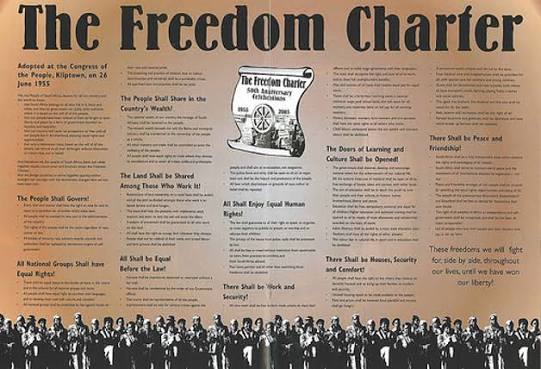
The ANC’s claim is not invented at the point of campaign messaging. It rests on a long genealogy of consequential policy documents that helped move South Africa from racial exclusion to democratic citizenship. These include the 1923 African Bill of Rights, the 1943 Africans’ Claims in South Africa, the 1955 Freedom Charter, the 1969 Strategy and Tactics, the 1991 Constitutional Principles for a Democratic South Africa, the 1992 Ready to Govern policy guidelines, the 1994 Reconstruction and Development Programme, the National Health Plan, the Women’s Charter for Effective Equality, the ANC’s policy proposals for the final Constitution, later election manifestos, and national conference resolutions on social transformation, economic reconstruction, education, health, land, local government and state capacity. The ANC’s own archive records that, after its unbanning and in the run-up to the 1994 election, it issued a series of policy documents, and that after 1994 it carried its policies through election manifestos and conference resolutions.
What gives this lineage political force is that these documents did not merely oppose apartheid in moral terms; they articulated a governing imagination. Ready to Govern set out guidelines for a democratic South Africa across constitutional design, local government, economic policy, land, housing, health, social welfare, education, sport, youth and international relations. It described ANC policy as directed towards overcoming colonial and apartheid injustice, developing state infrastructure, improving the quality of life of all South Africans, and building a non-racial, non-sexist and democratic society. The RDP then converted the long tradition of the Freedom Charter into a programme of government, explicitly identifying basic needs, human-resource development, economic reconstruction, democratisation of the state and implementation as linked tasks. When later governments expanded housing, social protection, public healthcare, education access and student funding, the ANC was therefore entitled to argue that these were not accidental administrative events, but outcomes traceable to a political programme repeatedly placed before the people.
To imagine that up until 1994 the majority of South Africans were denied rights that are now often taken for granted is to understand why the ANC cannot be expected to remain silent about the political programme it advanced. Its historic commitments included the right of all people to live where they chose, to be decently housed and to raise their families in comfort and security; the reduction of rents and prices; freedom from hunger; a state-run preventive health system; free medical care and hospitalisation, with special protection for mothers and young children; the replacement of slums with serviced communities connected by transport, roads, lighting, playing fields, crèches and social centres; state care for the aged, orphans, persons with disabilities and the sick; the recognition of rest, leisure and recreation as rights; and the abolition of fenced locations, ghettos and laws that divided families.
When a governing party can demonstrate that its policies and actions have moved society toward these long-declared objectives, and in fact show tangible results, it is not wrong to place that record before voters.
This right to claim policy victories does not cancel the right of other parties to contest for power. On the contrary, it strengthens democratic competition because it clarifies the record that must be tested. Other parties are entitled to say that they would implement the same social commitments better, correct failures in delivery, remove corruption, improve quality, expand coverage or redesign institutions while preserving the substance of the rights involved. They may also claim that particular achievements were the product of Parliament, courts, civil society, labour, communities, officials, provinces, municipalities, taxpayers and constitutional obligation rather than the work of one party alone. Multiparty democracy does not require historical amnesia. It requires that every party be free to present its programme, defend its record, challenge the record of others and ask voters for authority to continue, revise or deepen public policy.
7. Constitutional Purpose and Democratic Accountability
To the extent that the ANC claims these victories as part of its obligations to heal the divisions of the past and establish a society founded on democratic values, social justice and fundamental human rights, it is entitled to place its record before the electorate. These obligations include laying the foundations of a democratic and open society in which government is based on the will of the people and every citizen is equally protected by law; improving the quality of life of all citizens and freeing the potential of each person; and building a united and democratic South Africa capable of taking its rightful place as a sovereign state in the family of nations. But that claim must always be made inside, not above, the constitutional order. The ANC may say that it helped author and implement parts of the democratic settlement; it may not say that the democratic settlement belongs to it alone.
The claim is strengthened where these achievements can be connected to the constitutional values of human dignity, equality, the advancement of human rights and freedoms, non-racialism, non-sexism, constitutional supremacy and the rule of law. It must, however, remain subject to the equally important democratic requirements of universal suffrage, regular elections, a multiparty system, accountability, responsiveness and openness. In other words, the ANC may claim political responsibility for progress towards these objectives. Still, the people retain the right to assess the evidence, expose failures and decide whether the record merits renewed confidence.
8. Communicating the Record with Confidence and Discipline
This is therefore the moment for ANC Presidents, Ministers, MECs, Mayors, councillors and branch leaders, past and present, to step up in claiming the movement’s victories. They must no longer allow the democratic record of the past three decades to be narrated only through the language of failure, crisis and decline. With confidence, discipline and evidence, ANC leaders should explain how liberation-era commitments were translated into constitutional rights, progressive laws, public institutions and programmes that extended housing, social protection, education, healthcare and dignity to millions. This must become a sustained political-education and public-accountability campaign, not an episodic message delivered only when elections approach. Every leader should be able to connect a historic ANC commitment to a policy choice, a budget, an institution and a measurable outcome in the lives of citizens.
The call to action is clear: claim the victories, substantiate them and defend their democratic purpose. ANC leaders should take the record into communities, legislatures, councils, campuses, workplaces and public platforms; equip branches and public representatives with credible facts; acknowledge shortcomings without surrendering the achievements; and show how renewal will protect, improve and extend the gains already made. Public resources belong to the people, but political leadership still carries responsibility for the choices that created and sustained them. Silence concedes the narrative to others. The ANC must speak with one informed voice—not to demand gratitude, but to invite judgement on what it promised, what it delivered and what it now intends to deepen.
9. Conclusion: Claim the Record, Submit It to Judgement
In conclusion, it is not wrong for the ANC, or any governing party, to claim the outcomes of policies it conceived and implemented, provided that those claims are truthful, demonstrable and presented as an account of stewardship rather than ownership. Public programmes belong to the people, but political parties remain answerable for the choices through which those programmes are created, expanded or neglected. The proper democratic response is therefore neither to silence claims of achievement nor to accept them uncritically, but to test them against constitutional purpose, lived experience and measurable results.
Recommended References
African National Congress (ANC) (1943) Africans’ Claims in South Africa, 14 December. Available at: ANC (Accessed: 13 September 2026).
African National Congress (ANC) (1992) Ready to Govern: ANC Policy Guidelines for a Democratic South Africa, adopted at the National Conference, 31 May. Available at: ANC (Accessed: 13 September 2026).
African National Congress (ANC) (1993) A Bill of Rights for a New South Africa, 1 February. Available at: ANC (Accessed: 13 September 2026).
African National Congress (ANC) (1994) The Reconstruction and Development Programme. Johannesburg: ANC. Available at: ANC (Accessed: 13 September 2026).
African National Congress (ANC) (n.d.) Policy Documents. Available at: ANC (Accessed: 13 September 2026).
African National Congress (ANC) (n.d.) Official website. Available at: African National Congress (Accessed: 13 September 2026).
Department of Justice and Constitutional Development (1996) Constitution of the Republic of South Africa, 1996. Pretoria: Government of South Africa. Available at: Department of Justice and Constitutional Development (Accessed: 13 September 2026).
Mandela, N.R. (1996) ‘Address on the 41st anniversary of the Freedom Charter’, Kliptown, 26 June.
Ntanzi, H. (2026) ‘Mantashe rejects “vote-buying” claims over RDP houses, social grants’, Weekend Argus, 8 September. Available at: Weekend Argus (Accessed: 13 September 2026).
South African History Online (2011) ‘The Freedom Charter’, 31 March, updated 21 July 2026. Available at: South African History Online (Accessed: 13 September 2026).
Callinicos, L. (2004) Oliver Tambo: Beyond the Engeli Mountains. Cape Town: David Philip/New Africa Books. Available at: Google Books (Accessed: 13 September 2026).
Gumede, W.M. (2007) Thabo Mbeki and the Battle for the Soul of the ANC. London: Zed Books. Available at: Bloomsbury (Accessed: 13 September 2026).
Maharaj, M. and Jordan, Z.P. (2021) Breakthrough: The Struggles and Secret Talks that Brought Apartheid South Africa to the Negotiating Table. Cape Town: Penguin Books South Africa. Available at: Penguin Random House South Africa (Accessed: 13 September 2026).
Mangcu, X. (2013) Biko: A Life. London: I.B. Tauris. Available at: Bloomsbury (Accessed: 13 September 2026).
South African Democracy Education Trust (SADET) (2008) The Road to Democracy in South Africa, Volume 4: 1980–1990. Pretoria: UNISA Press. Available at: UNISA Press (Accessed: 13 September 2026).
Carrim, Y. (2025) Attacking the Heart of Apartheid: The ANC’s Special Operations Unit. Cape Town: Penguin Books South Africa. Available at: Penguin Random House South Africa (Accessed: 13 September 2026).
Haricharan, S. and Gunn, S. (2019) Voices from the Underground: Eighteen Life Stories from Umkhonto we Sizwe’s Ashley Kriel Detachment. Cape Town: Penguin Books South Africa. Available at: Penguin Random House South Africa (Accessed: 13 September 2026).
Ngcukaitobi, T. (2021) Land Matters: South Africa’s Failed Land Reforms and the Road Ahead. Cape Town: Penguin Books South Africa. Available at: Penguin Random House South Africa (Accessed: 13 September 2026).
Phosa, M. (2024) Witness to Power. Cape Town: Penguin Books South Africa. Available at: Penguin Random House South Africa (Accessed: 13 September 2026).
Seale, L. (2024) One Hundred Years of Dispossession: My Family’s Quest to Reclaim Our Land. Johannesburg: Jacana Media. Available at: Jacana Media (Accessed: 13 September 2026).
Simpson, T. (2021) History of South Africa: From 1902 to the Present. Cape Town: Penguin Books South Africa. Available at: Penguin Random House South Africa (Accessed: 13 September 2026).
Sithole, M. and Calland, R. (2022) The Presidents: From Mandela to Ramaphosa, Leadership in the Age of Crisis. Cape Town: Penguin Books South Africa. Available at: Penguin Random House South Africa (Accessed: 13 September 2026).







Leave A Comment