
South Africa cannot defeat organised crime while its institutions plan, budget and act in silos.
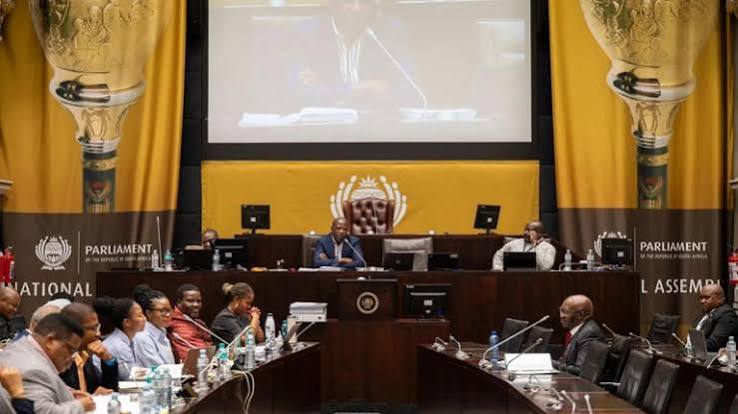
Lieutenant-General Nhlanhla Mkhwanazi’s intervention in Parliament should be read as more than another dramatic episode in the crisis engulfing the criminal justice system. Beneath the allegations, institutional rivalries and political contestation lies a deeper warning: South Africa is confronting integrated criminal networks with a fragmented state.
Mkhwanazi has become an influential voice on the direction of policing because he combines operational knowledge with an unusually clear account of its institutional logic. His resistance to criminal syndicates has earned public trust and given his intervention significance beyond the office of a provincial police commissioner. In a country weary of evasive leadership, professional competence, candour and moral purpose carry unusual weight.
Criminal syndicates respect neither departmental mandates nor provincial and municipal boundaries. They move money through legitimate businesses, exploit procurement systems, corrupt officials, infiltrate policing structures and use transport, property and communications networks across jurisdictions. The institutions expected to confront them, however, still operate through separate plans, budgets, databases and chains of command.
One state, one constitutional duty
That is why Mkhwanazi’s remarks matter beyond policing: they expose the neglected security meaning of cooperative government. Chapter 3 does not merely commend cooperation. Sections 40 and 41 establish national, provincial and local government as distinctive, interdependent and interrelated spheres, bound to secure the people’s well-being through effective, transparent, accountable and coherent government. The Constitution creates one cooperative system of government—not three spheres free to retreat into silos.
Within that architecture, section 205 must remain sacrosanct. It establishes a national police service structured to function nationally, provincially and, where appropriate, locally. It also fixes the service’s objects: to prevent, combat and investigate crime; maintain public order; protect the Republic’s inhabitants and their property; and uphold and enforce the law. Cooperative government cannot dilute or redistribute that mandate. It must organise the wider state around its fulfilment.
Safety starts beyond the police station.
Section 205 places policing at the centre of the constitutional response to crime, but it does not make the police the sole producer of public safety. Town planning determines whether neighbourhoods have adequate lighting, accessible roads and safe public spaces. Public works determines whether police stations, courts and border facilities function. Procurement determines whether vehicles, technology and protective equipment arrive on time and at a fair price. Municipal police, traffic authorities, border management, revenue services, prosecutors, correctional services and oversight bodies each hold part of the security puzzle. Cooperative government becomes real when these powers support—not supplant—the section 205 mandate around one place-based safety objective.
When institutions fail to share intelligence, align priorities or clarify authority, criminals gain the advantage. The problem is not simply a shortage of police officers; it is a shortage of state coherence. A fragmented state is predictable, slow and easy to manipulate. A cooperative state can mobilise every sphere around the police service’s constitutional objects while preserving lawful command and accountability.
The District Development Model provides a potentially useful architecture for aligning plans and budgets across the 44 districts and eight metropolitan municipalities. But it must become more than a service-delivery slogan. Every district plan should include an intelligence-led safety compact identifying crime patterns, environmental risks, infrastructure failures, enforcement responsibilities and measurable outcomes. Police, municipalities, prosecutors, social-development agencies, transport authorities, business and communities should work from the same local threat assessment. Such compacts must serve section 205—not create rival command centres. Yet even coherent structures will fail if the state cannot trust those appointed to exercise its coercive powers.
Who gets the badge?
This is where cooperative government meets institutional integrity. Because section 205 entrusts police officers with exceptional powers, recruitment cannot be treated as an ordinary personnel exercise. An appointment confers authority to carry a firearm, access sensitive information, restrict liberty and enter spaces closed to ordinary citizens. The decisive question is not simply whether an applicant meets academic and physical requirements, but whether that person can be trusted to exercise public power in fidelity to the Constitution.
How, then, does the service distinguish a genuine career officer from a gangster seeking a uniform, a firearm and access to intelligence? No single test can do so. A clean criminal record is necessary but insufficient: sophisticated actors may have no conviction, conceal their associations or recruit candidates with apparently unblemished histories. The answer is layered scrutiny of identity, history, judgement, integrity, finances, associations and conduct over time.
Entry controls already include sworn disclosure, fingerprinting, background and criminal-record checks, psychological assessment, medical and physical evaluation, training and probation. They need to be deeper, independent and auditable, drawing lawfully on the capacities of several organs of state rather than a single police database or command structure. Panels should verify qualifications, employment and residential histories, references and identity; conduct lawful conflict-of-interest, financial-risk and association screening; assess integrity and judgement; and record reasons for every appointment. Unexplained intervention by a politician, commander or union official should trigger automatic review.
Vetting must continue after enlistment. Probation should test supervised field performance, ethics and community-facing conduct. Periodic re-vetting is especially important in intelligence, organised crime, firearms, evidence, procurement and border functions. Lifestyle discrepancies, undeclared outside interests, repeated association with known criminals, unauthorised database access, evidence irregularities or attempts to compromise investigations should trigger timely, risk-based inquiry—not instant guilt. Protected whistle-blower channels outside the ordinary chain of command are essential.
The controls must themselves be controlled. Screening cannot become an instrument of factional purges, political exclusion or discrimination. Independent oversight, documented criteria, appeal mechanisms, data protection and consequences for manipulated recruitment are indispensable. The Independent Police Investigative Directorate investigates specified criminality by police members, while internal integrity structures, civilian oversight, Parliament and the Auditor-General should scrutinise recruitment, promotion and deployment systems. Each has a distinct mandate; none can protect policing integrity alone. The badge must never become camouflage for organised crime.
When professionals enable crime
The inquiry cannot end with the badge. Organised crime survives by purchasing or manipulating professional expertise across the justice system. Legal practitioners are indispensable to constitutional democracy, but some may become enablers when trust accounts, companies, property transactions, litigation tactics or claims of privilege are abused to conceal ownership, move illicit proceeds, intimidate witnesses or frustrate investigations. The point is not to stigmatise a profession. It is to recognise that specialised knowledge can serve justice—or be weaponised against it.
The same risk exists across the institutional chain. A judicial officer, court official or intermediary could distort scheduling, records, warrants, bail or case allocation. A prosecutor could weaken a charge, mishandle evidence, delay a matter or disclose strategy. A correctional official could facilitate illicit communication, contraband, preferential treatment or escape planning. Security and intelligence personnel could sell information, misdirect surveillance, compromise witnesses or shield syndicates. A single compromised actor at a strategic point can undo months of sound police work.
Judicial independence, prosecutorial discretion, legal professional privilege and intelligence secrecy are constitutional safeguards—not presumptions of immunity. Protecting them requires an intergovernmental and inter-institutional integrity system: risk-based vetting for sensitive posts, auditable case-allocation and access logs, financial and conflict-of-interest disclosure, lawful information sharing, protected reporting, independent investigation and firm professional discipline. Safeguards must remain proportionate and respect due process. Cooperative government cannot become political control over courts, prosecutors, lawyers or intelligence bodies, nor may coordination trespass on the lawful command and accountability of the police service. The task is to coordinate power without collapsing the constitutional boundaries that make accountability possible.
Make coordination count
That balance—coordination without institutional capture—must shape reform. South Africa does not lack forums, committees or memoranda of understanding. It lacks consequences when coordination fails. Parliament should review the laws and reporting arrangements governing the criminal justice cluster, clarify the boundary between political authority and operational command, and require joint reporting on shared security outcomes. Chapter 3 establishes cooperative government; section 205 secures the objects and integrity of the police service within it. Accountability must follow the intergovernmental chain rather than vanish between mandates.
Six reforms are urgent. First, create permanent joint operational centres in crime hotspots, linking national, provincial and municipal capacities through lawful information sharing and clear command. Second, align policing and prosecution priorities with municipal development plans and district “One Plans”, so every sphere budgets for its contribution without confusing support for policing with control of policing. Third, measure common outcomes—including disrupted networks, case readiness, convictions and recovered criminal assets—instead of isolated institutional activity. Fourth, require joint public reporting that identifies responsibility, commitments and results. Fifth, establish an independently audited, multi-agency integrity regime covering recruitment, training, probation, promotion and deployment. Sixth, create a professional-enablers strategy combining financial intelligence, professional regulation, access auditing and independent investigation to expose officials or practitioners who knowingly strengthen criminal networks.
This does not require blurred mandates or weaker oversight. Cooperative government is not institutional fusion. Sections 40 and 41 require interdependence and coherent action; section 205 protects the objects and institutional place of the police service. Read together, they demand cooperation without encroachment. Distinct institutions must exercise their lawful powers within a shared strategy, exchange information lawfully and accept collective responsibility for outcomes. Operational independence matters precisely because coordination must never become a pretext for political interference.
Mkhwanazi has forced the country to confront the architecture of public safety. The lesson is uncomfortable: the state cannot defeat organised crime through another isolated strategy in another isolated department—or by commissioning people whose loyalty is to criminal networks rather than the Constitution. It must govern as Chapter 3 commands: through distinctive, interdependent and interrelated spheres. Within that order, section 205 must remain sacrosanct—not isolated from government, but protected from dilution as every sphere and organ of state is organised around its fulfilment. Cooperative government is not peripheral to the fight against crime. It is the constitutional method by which the police mandate must be enabled, supported and held accountable.
Crime thrives where government fragments. South Africa’s first security reform is to make the state act as one.











Leave A Comment